
Nuforme Research Team · · · 6 min read
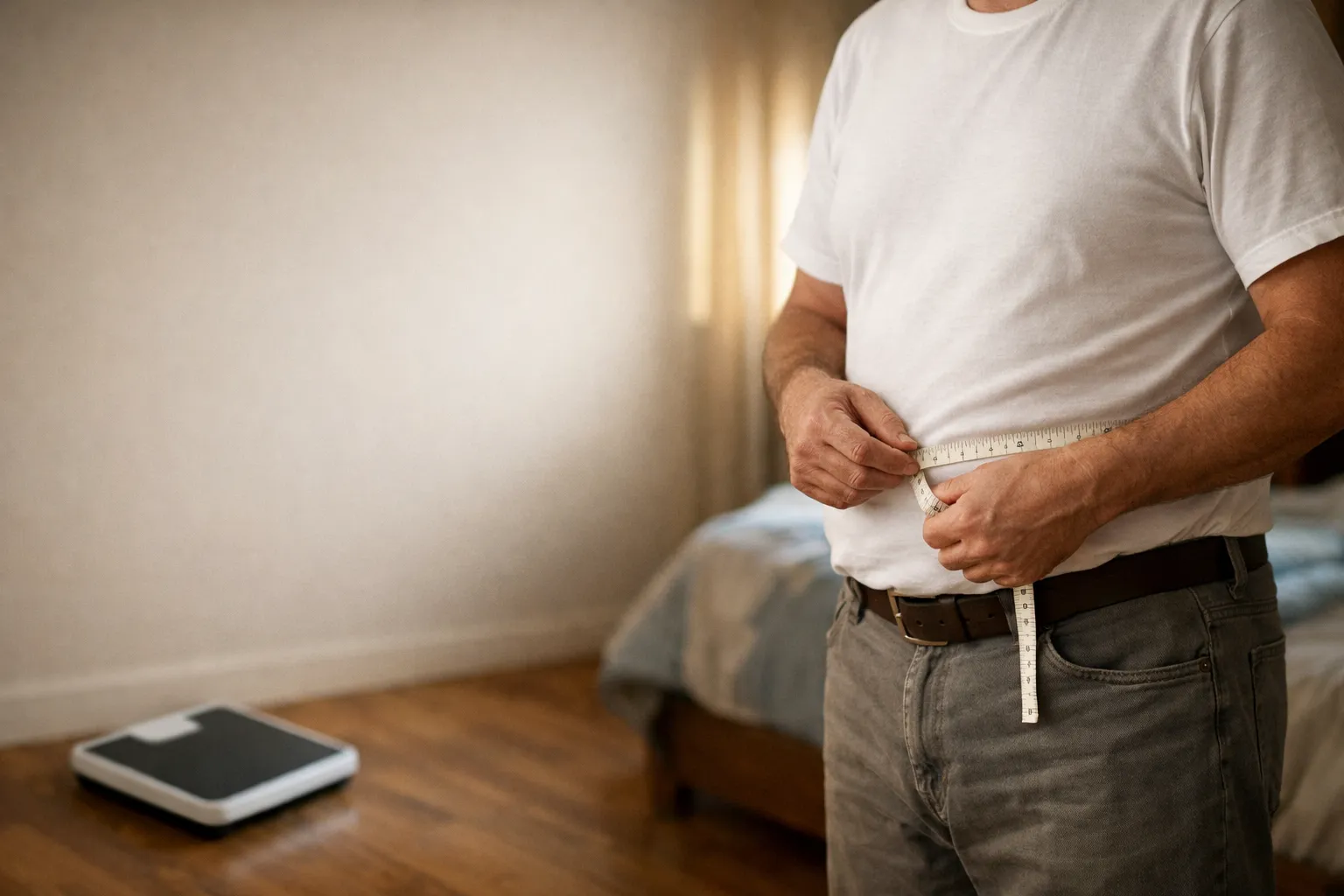
A changing waistline can be confusing when the bathroom scale barely moves. In midlife, after menopause, or during any period of metabolic change, the question is often more specific than weight: can the deeper abdominal fat around organs change even when body weight does not?
Tesamorelin trials are useful here because they measured fat with CT, MRI, and magnetic resonance spectroscopy rather than relying only on scale weight. They do not answer ordinary weight-management questions for the general public. They do show why visceral adipose tissue is a different measurement from body weight, waist circumference, subcutaneous fat, or liver fat.
Research Confidence
★★★★☆
Confidence is strong for the measurement question because multiple randomized, placebo-controlled human trials used imaging endpoints over 6 to 12 months. It is not five stars because most participants had HIV-associated abdominal fat accumulation, most were men, and long-term clinical outcomes were not established.
Study Snapshot
- Study type: pooled analysis of two multicenter, double-blind, placebo-controlled phase 3 trials
- Participants: 806 adults on antiretroviral therapy with HIV-associated excess abdominal fat
- Duration: 26-week randomized phase plus 26-week extension
- Measured: CT-measured visceral adipose tissue at week 26
- Found: VAT changed -24 ± 41 cm² with tesamorelin versus +2 ± 35 cm² with placebo
- Funding: phase 3 trials were industry sponsored
Why This Matters
The scale is a blunt instrument. It cannot tell whether weight reflects muscle, water, fat under the skin, or fat stored deeper in the abdomen.
That distinction matters in midlife because body composition can shift even when weight looks stable. A person may notice a thicker waist, a different fit through the abdomen, or less confidence that weight tells the whole story. For perimenopausal and postmenopausal readers, the question is especially relevant because abdominal fat distribution can change with age and hormonal transition. The tesamorelin literature does not directly study menopause-related fat redistribution, but it gives a clear lesson: what researchers measure determines what they can honestly claim.
Visceral Adipose Tissue Is Not Belly Size
A tape measure can tell you that an abdomen is larger. It cannot tell you where the fat is.
Visceral adipose tissue, often shortened to VAT, is fat stored inside the abdominal cavity around internal organs. Subcutaneous abdominal fat is the softer, pinchable fat under the skin. The two can move differently.
In the pooled human phase 3 analysis of 806 adults with HIV-associated abdominal fat, tesamorelin was studied against placebo for 26 weeks using CT scans. CT is an imaging test that can separate deeper abdominal fat from fat under the skin. VAT fell more in the tesamorelin group, while abdominal subcutaneous fat did not show a matching significant reduction.
That is the core measurement lesson. A change in visceral adipose tissue is not the same claim as weight loss, cosmetic abdominal change, or a smaller clothing size.
Where Tesamorelin Fits In This Research
Tesamorelin is a growth hormone-releasing factor analogue, meaning it is designed to stimulate the body’s own growth hormone signaling rather than supply growth hormone directly. In the United States, FDA-approved tesamorelin products are prescription biologics for reducing excess abdominal fat in adults with HIV-associated lipodystrophy. FDA labeling also states they are not indicated for weight-loss management.
In a 412-participant randomized, double-blind, placebo-controlled human trial, tesamorelin 2 mg by daily subcutaneous injection was compared with placebo for 26 weeks. VAT decreased 15.2% in the tesamorelin group and increased 5.0% in placebo. Triglycerides and the cholesterol-to-HDL ratio also moved favourably, while more participants in the tesamorelin arm withdrew because of adverse events.
A second phase 3 randomized human trial enrolled 404 adults and used the same 6-month randomized design, followed by a safety extension. VAT decreased 10.9% with tesamorelin versus 0.6% with placebo. When participants switched from tesamorelin to placebo in the extension, VAT reduction was rapidly lost.
Liver Fat Shows Why Imaging Endpoints Matter
Liver fat adds another layer because it cannot be judged by the mirror or the scale.
In a 50-participant randomized, double-blind, placebo-controlled human trial published in JAMA, tesamorelin 2 mg daily was compared with placebo for 6 months. VAT was measured by CT, and liver fat was measured by proton magnetic resonance spectroscopy, a scan-based method that estimates fat inside liver tissue. VAT changed by -34 cm² with tesamorelin versus +8 cm² with placebo, and liver fat decreased modestly. Fasting glucose rose at 2 weeks, but 6-month glucose changes were not statistically significant.
In a 61-participant randomized, double-blind, multicentre human trial in people with HIV and non-alcoholic fatty liver disease, tesamorelin was compared with placebo for 12 months. Liver fat fell more with tesamorelin, with an absolute effect of -4.1 percentage points, and MRI-measured VAT also decreased more than placebo. Injection-site complaints were more common with tesamorelin, but none were judged serious.
What This Means For You
If you are tracking abdominal change, weight alone can miss the part researchers may care about most. Waist circumference is more useful than the scale, but it still cannot separate visceral adipose tissue from subcutaneous fat.
The tesamorelin evidence does not license a do-it-yourself interpretation for general midlife weight management. It shows that in selected clinical populations, imaging found changes that ordinary weight tracking could not fully describe. A practical takeaway is to ask what endpoint a study actually measured before accepting a claim about abdominal fat. Scale weight, waist size, CT-measured VAT, and liver fat are related, but they are not interchangeable.
What This Tells Us About Women Specifically
Women were present but underrepresented. The pivotal phase 3 program was about 84% male. The JAMA 2014 trial enrolled 8 women out of 50, and the Lancet HIV 2019 trial enrolled 13 women out of 61.
Menopausal status was reported in the JAMA trial for women, but not consistently across the evidence base. Results were not meaningfully broken out by sex or menopausal status. That matters because midlife women may be reading this through a menopause lens, while the strongest tesamorelin data come from mostly male HIV-associated lipodystrophy populations.
Questions This Study Couldn't Answer
Several gaps are still real:
- The trials do not directly answer menopause-related abdominal fat redistribution.
- Most evidence comes from people with HIV-associated abdominal fat accumulation or HIV-related fatty liver disease.
- Women and adults over 65 were not well represented.
- Imaging changes were surrogate endpoints, meaning stand-ins for health outcomes, not proof of fewer heart attacks or diabetes events.
- The FDA label notes that long-term cardiovascular safety has not been established.
- Industry sponsorship was present in the pivotal trials.
Future Research
Confidence would rise with a large, independent randomized trial in a non-HIV midlife metabolic population. It would need balanced enrollment by sex, clear menopausal-status reporting, imaging-confirmed visceral adipose tissue endpoints, and follow-up after stopping treatment. Prespecified sex-stratified analyses would be especially important.
Research Use And Availability
Nuforme supplies Tesamorelin in Canada as a research peptide for research use only, with documentation and third-party testing standards applied to catalogue materials. This should not be conflated with FDA-approved prescription EGRIFTA products. Health Canada records show EGRIFTA received a Notice of Compliance in 2014, while the database listing found for this brief showed cancelled post-market status. Relevant internal pages include Weight Management, Anti-Aging, and Understanding research peptides.
Final Thoughts
The honest answer is yes: visceral adipose tissue can change in ways the scale may not capture. But the strongest tesamorelin evidence is not a general weight-loss story. It is a measurement story, built on imaging trials in specific clinical populations, and it should be read with that boundary intact.
Frequently asked questions
- Is visceral adipose tissue the same as belly fat?
- Not exactly. Visceral adipose tissue is deeper fat around abdominal organs. Belly size can also reflect subcutaneous fat under the skin, muscle, water, posture, or bloating, so a tape measure cannot identify VAT on its own.
- Do tesamorelin studies prove weight loss in midlife adults?
- No. The strongest trials studied mostly adults with HIV-associated abdominal fat accumulation and used imaging endpoints. FDA labeling for approved tesamorelin products also states they are not indicated for weight-loss management.
- Why did these studies use CT, MRI, or spectroscopy?
- Those methods can separate compartments that the scale cannot. CT and MRI can estimate visceral fat, while magnetic resonance spectroscopy can estimate liver fat. That makes the endpoint more precise, but it also means the finding is not the same as ordinary weight loss.
- How strong is the evidence for women specifically?
- Limited. Women made up a small minority of participants in the pivotal trials, and menopausal status was not consistently reported. That makes it hard to know whether results differ by sex, menopause stage, or hormone therapy use.
References
Peer-reviewed sources cited in this article. Nuforme products are research materials; these studies are provided for literature context and are not claims about any product.
- [1]Falutz J, Allas S, Blot K, et al. Metabolic Effects of a Growth Hormone-Releasing Factor in Patients with HIV. N Engl J Med. 2007;357:2359-2370. doi:10.1056/NEJMoa072375.
Human randomized, double-blind, placebo-controlled trial; 26 · n = 412 randomized; tesamorelin n=275, placebo n=137. · 26-week randomized main phase plus 26-week extension. · Primary endpoint: percent change from baseline in visceral adipose tissue measured by CT scan. Secondary endpoints included triglycerides, cholesterol/HDL ratio, IGF-1, glycemic measures, and self-assessed body image.
VAT decreased 15.2% in the tesamorelin arm and increased 5.0% in placebo; triglycerides and cholesterol/HDL ratio also moved favorably, while more tesamorelin participants withdrew because of adverse events.
- [2]Falutz J, Potvin D, Mamputu JC, et al. Effects of tesamorelin, a growth hormone-releasing factor, in HIV-infected patients with abdominal fat accumulation: a randomized placebo-controlled trial with a safety extension. J Acquir Immune Defic Syndr. 2010;53(3):311-322. doi:10.1097/QAI.0b013e3181cbdaff.
Human randomized, double-blind, placebo-controlled phase 3 · n = 404 randomized; tesamorelin n=275, placebo n=129 per CADTH/, · 6-month randomized phase; 12-month total with safety extension. · Primary endpoint: VAT. Secondary endpoints included body image, IGF-1, glucose safety, waist measures, and other body composition measures.
VAT decreased 10.9% with tesamorelin versus 0.6% with placebo over 6 months; VAT reduction was maintained with continued treatment and was rapidly lost after switching from tesamorelin to placebo.
- [3]Falutz J, Mamputu JC, Potvin D, et al. Effects of tesamorelin (TH9507), a growth hormone-releasing factor analog, in HIV-infected patients with excess abdominal fat: a pooled analysis of two multicenter, double-blind placebo-controlled phase 3 trials with safety extension data. J Clin Endocrinol Metab. 2010;95(9):4291-4304. doi:10.1210/jc.2010-0490.
Pooled analysis of two human multicenter randomized, double- · n = 806 ART-treated HIV participants randomized; tesamorelin n=. · 26-week randomized intervention phase plus 26-week safety extension. · Primary outcome: percent change in CT-measured VAT at week 26.
At week 26, VAT changed by -24 ± 41 cm² with tesamorelin versus +2 ± 35 cm² with placebo, for a reported treatment effect of -15.4%; abdominal subcutaneous fat did not show a significant corresponding reduction.
- [4]Stanley TL, Feldpausch MN, Oh J, et al. Effect of Tesamorelin on Visceral Fat and Liver Fat in HIV-Infected Patients With Abdominal Fat Accumulation: A Randomized Clinical Trial. JAMA. 2014;312(4):380-389. doi:10.1001/jama.2014.8334.
Human randomized, double-blind, placebo-controlled mechan · n = 50 randomized and underwent baseline assessment; tesamorelin · 6 months. · Co-primary endpoints: changes in visceral adipose tissue and liver fat. VAT was measured by single-slice CT at L4; liver fat by 1H-MRS lipid-to-water percentage. Secondary endpoints included glucose and other metabolic measures.
VAT changed -34 cm² with tesamorelin versus +8 cm² with placebo, a -42 cm² treatment effect; liver fat also decreased modestly. Fasting glucose rose at 2 weeks but 6-month glucose changes were not statistically significant.
- [5]Stanley TL, Fourman LT, Feldpausch MN, et al. Effects of tesamorelin on non-alcoholic fatty liver disease in HIV: a randomised, double-blind, multicentre trial. Lancet HIV. 2019;6(12):e821-e830. doi:10.1016/S2352-3018(19)30338-8.
Human randomized, double-blind, multicenter placebo · n = 61 enrolled; 31 randomized to tesamorelin and 30 to placebo; · 12-month randomized phase plus 6-month open-label phase. · Primary endpoint: change in hepatic fat fraction by proton MRS. Secondary adipose endpoint: MRI-measured VAT. Primary safety endpoint: glucose.
Hepatic fat fraction fell more with tesamorelin than placebo, with an absolute effect size of -4.1 percentage points and relative reduction of -37%; VAT also decreased more than placebo. Injection-site complaints were more common with tesamorelin, but none were judged serious.
- [6]Bredella MA, Lin E, Brick DJ, et al. Metabolic Effects of a Growth Hormone-Releasing Factor in Obese Subjects with Reduced Growth Hormone Secretion: A Randomized Controlled Trial. J Clin Endocrinol Metab. 2012;97(12):4769-4779. doi:10.1210/jc.2012-2631.
Human randomized, double-blind, placebo-controlled trial in · n = 60 randomized; 58 initiated treatment, tesamorelin n=29 and · 12 months. · Primary body-composition endpoint included abdominal VAT by CT; cardiovascular risk indices included carotid intima-media thickness by ultrasound, lipids, CRP, and glucose safety measures.
In abdominally obese adults with reduced GH secretion, VAT changed -16 ± 9 cm² with tesamorelin versus +19 ± 9 cm² with placebo, giving a -35 cm² treatment effect; investigators reported no worsening of glucose.
Keep reading
- What Visceral Fat Tesamorelin Trials Actually Measure
Tesamorelin trials show why visceral fat can change on imaging while body weight barely moves, but the evidence is mainly in HIV-associated lipodystrophy.
- Tesamorelin Canada: What the Record and Trials Actually Say
A historic Canadian authorization and a cancelled DIN can sound contradictory. Here is what the record says, alongside the human trials that made tesamorelin worth studying.
- What Retatrutide Trials Measure Beyond Weight Loss
Modern retatrutide trials track more than kilograms. Here is what researchers measured for glucose, liver fat, body composition, waist, lipids, and safety.