
Nuforme Research Team · · · 6 min read
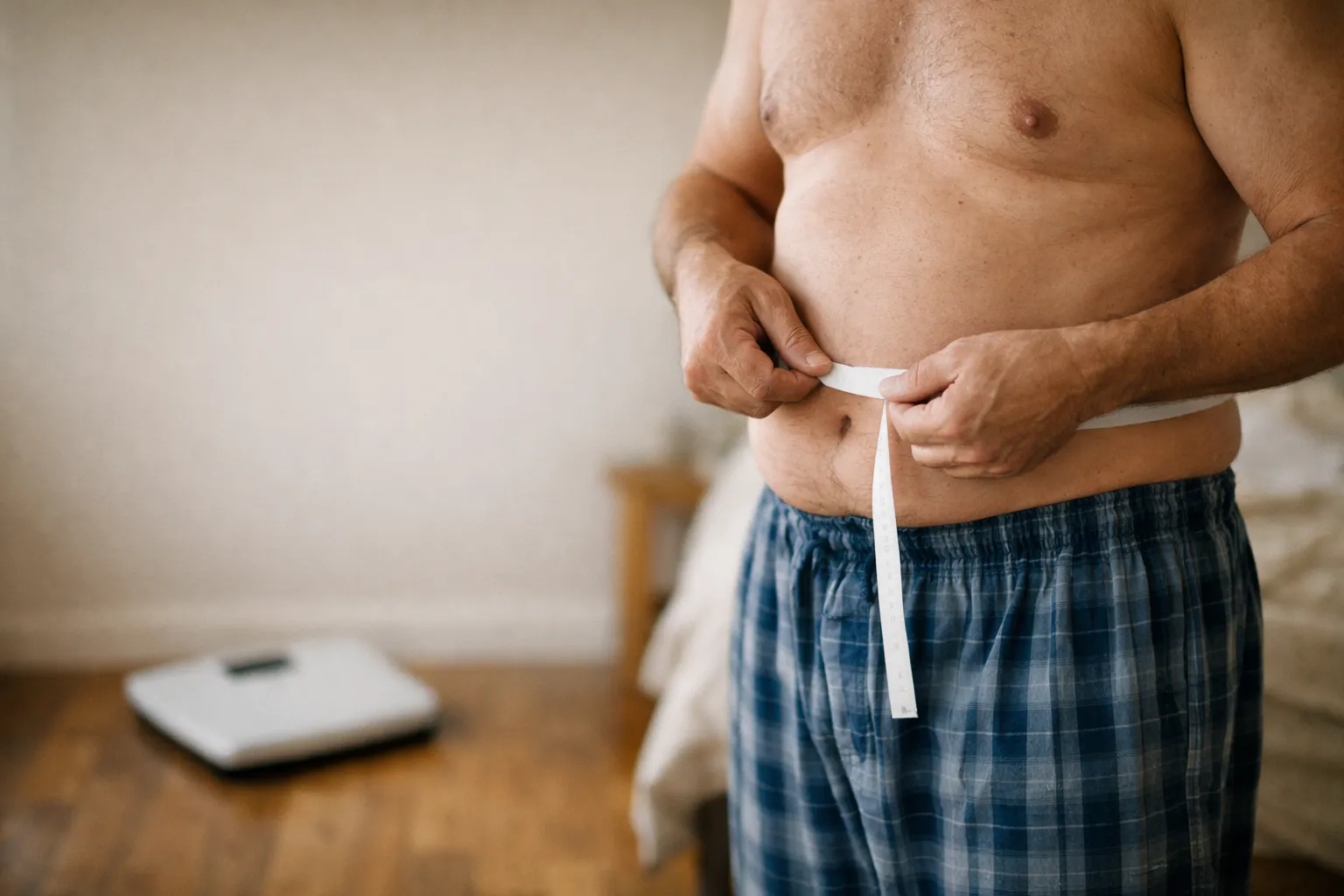
A scale can be stubbornly unhelpful. Someone may lose deep abdominal fat, gain or keep lean tissue, and still see almost the same body weight. That is the question behind the visceral fat tesamorelin trials: can researchers measure a meaningful change in belly fat when weight barely changes?
The answer is yes, in a specific research setting. Several randomized human trials in adults with HIV-associated abdominal fat accumulation found less imaging-measured visceral adipose tissue with tesamorelin, while body weight and under-the-skin abdominal fat changed little. Those trials do not prove general weight-loss effects for midlife adults without HIV.
Research Confidence
★★★★☆ Four stars for the measurement question. Multiple randomized, double-blind, placebo-controlled human trials measured visceral fat by CT or magnetic resonance methods over 26 weeks to 12 months, but participants were mostly men with HIV-associated abdominal adiposity, and long-term clinical outcomes remain unsettled.
Study Snapshot
- Study type: pooled analysis of two randomized, double-blind, placebo-controlled phase 3 trials
- Participants: 806 adults with HIV and excess abdominal fat, about 15% women
- Duration: 26-week main phase plus 26-week extension data
- Measured: visceral adipose tissue by CT imaging
- Found: 15.4% placebo-adjusted visceral fat reduction at week 26
- Funding: pivotal trials funded by Theratechnologies
Why This Matters
Midlife abdominal change is easy to notice and hard to interpret. Waistbands tighten, body composition shifts, and after menopause many people see more fat stored centrally. The scale may not explain what is happening because it cannot separate deep abdominal fat from subcutaneous fat, fluid, muscle, or ordinary day-to-day variation.
That distinction matters because visceral fat sits inside the abdominal cavity around organs. Subcutaneous fat sits under the skin. A tape measure sees both at once. CT imaging separates them. The tesamorelin literature is useful because it forces that measurement issue into the open: a study can report less visceral fat without reporting much weight loss.
Why CT Imaging Changed the Question
The pivotal tesamorelin trials did not rely on before-and-after waist size alone. They used computed tomography, or CT, at the L4-L5 level of the spine. In plain English, researchers took a standardized abdominal image and estimated the area of deep abdominal fat.
In the 2007 randomized, double-blind, placebo-controlled phase 3 trial of 412 adults with HIV, tesamorelin was compared with placebo for 26 weeks. The trial regimen was tesamorelin 2 mg by subcutaneous injection daily, described here only as the study design. Visceral adipose tissue fell by 27.8 cm² in the tesamorelin group and rose by 5.1 cm² in the placebo group.
A second multicentre randomized, double-blind, placebo-controlled trial randomized 404 adults. At 26 weeks, visceral fat changed by minus 10.9%, or minus 21 cm², with tesamorelin compared with minus 0.6%, or minus 1 cm², with placebo.
These are imaging outcomes. They are not the same as looking leaner, losing pounds, or changing clothing size.
Where Tesamorelin Fits in Visceral Fat Research
Tesamorelin is a growth hormone-releasing factor analogue. In simple terms, it is designed to stimulate the body’s growth hormone pathway rather than supply growth hormone directly. The visceral fat tesamorelin trials tested that approach in HIV-associated lipodystrophy, a body-fat redistribution syndrome seen in some people living with HIV.
A pooled analysis of the two phase 3 randomized trials included 806 adults. At 26 weeks, visceral fat changed by minus 24 cm² with tesamorelin and plus 2 cm² with placebo, a 15.4% placebo-adjusted effect. Abdominal subcutaneous fat did not significantly change, and FDA label summaries describe body weight as essentially neutral.
Regulatory status matters here. FDA-approved EGRIFTA products contain tesamorelin and are licensed prescription products for reducing excess abdominal fat in adults with HIV and lipodystrophy. The label also states they are not indicated for weight-loss management and that long-term cardiovascular safety has not been established.
That makes this a narrow evidence base, not a general “belly fat” story.
Why Body Weight Can Miss the Signal
Later randomized trials kept the same measurement lesson but asked related metabolic questions. In a 50-person randomized, double-blind, placebo-controlled JAMA trial, adults with HIV and abdominal fat accumulation were studied for 6 months. Visceral fat changed by minus 34 cm² with tesamorelin versus plus 8 cm² with placebo, a treatment effect of minus 42 cm².
That trial also measured liver fat by proton magnetic resonance spectroscopy, a scan-based method for estimating fat inside the liver. Liver fat decreased modestly. Serious adverse events occurred in 3 participants in each arm. Fasting glucose rose at 2 weeks, but 6-month fasting and 2-hour glucose changes were not significantly different between groups.
In a 61-person randomized, double-blind Lancet HIV trial in HIV-associated fatty liver disease, hepatic fat fraction fell more with tesamorelin than placebo, with an absolute effect of minus 4.1%. Visceral fat also decreased more, with a treatment effect of minus 35 cm², while BMI and waist circumference did not significantly change. Injection-site complaints were more common with tesamorelin.
What This Means For You
The practical lesson is about measurement, not self-experimentation. If the question is deep abdominal fat, body weight is a blunt instrument. Waist circumference is useful, but it still blends several tissues into one number.
For a clinician-led discussion, the key question is what is being measured and why: weight, waist, visceral fat on imaging, liver fat, glucose markers, lipids, or symptoms. A reasonable reading of the tesamorelin trials is that imaging can detect visceral-fat changes that the scale misses. It is not reasonable to carry those findings into ordinary midlife weight management without comparable trials.
What This Tells Us About Women Specifically
Women were included, but they were underrepresented. The pooled phase 3 analysis included 121 women out of 806 participants, about 15%. The 50-person JAMA trial included 8 women, and the 61-person Lancet HIV trial included 13 women.
Menopausal status was not reported, hormone therapy use was not accounted for in the briefed studies, and results were not meaningfully broken down by menopause stage. The pooled phase 3 paper reported a limited sex analysis suggesting similar visceral-fat response in females and males, but that is not the same as a menopause-specific evidence base.
Questions This Study Couldn't Answer
- Whether tesamorelin-related visceral-fat changes reduce cardiovascular events or other long-term clinical outcomes.
- Whether similar results occur in adults without HIV-associated lipodystrophy.
- How perimenopause, menopause, estradiol change, or hormone therapy might modify response.
- What happens after stopping treatment over longer follow-up; extension data showed visceral fat was not sustained after discontinuation.
- Dropout patterns and tolerability details were not consistently extractable from the briefed sources.
Future Research
Confidence would rise with independently funded randomized trials that enroll women and men in balanced numbers, record menopausal status, prespecify sex-stratified outcomes, and follow participants after discontinuation. Imaging endpoints are useful, but clinical endpoints would tell readers whether a scan change translates into health outcomes.
Research Use And Availability
Tesamorelin is supplied by Nuforme in Canada as a research peptide, distinct from FDA-approved prescription tesamorelin products. Nuforme’s research materials are designated for research use only and are not intended for human use. Relevant site context includes Weight Management and Understanding research peptides.
Final Thoughts
Yes, visceral fat can fall in a study while body weight stays nearly unchanged. The best tesamorelin evidence shows that clearly in HIV-associated abdominal fat research. The honest boundary is just as clear: those trials explain a measurement phenomenon in a narrow population, not a general midlife weight-loss claim.
Frequently asked questions
- Do tesamorelin trials prove weight loss?
- No. The strongest trials measured visceral adipose tissue by CT imaging and found reductions in that specific fat depot, while body weight changed little. The FDA label for approved tesamorelin products also states they are not indicated for weight-loss management.
- Is visceral fat the same as belly size?
- Not exactly. Visceral fat sits deeper in the abdomen around organs, while belly size also reflects subcutaneous fat, muscle, fluid, posture, and measurement variation. CT or magnetic resonance methods can separate tissues more precisely than a tape measure.
- How good is the evidence for women in midlife?
- The evidence is limited for that specific question. Women made up about 15% of the pooled phase 3 tesamorelin dataset, menopausal status was not reported, and the trials were mainly in HIV-associated lipodystrophy rather than typical perimenopause or menopause.
- What did researchers observe after stopping tesamorelin?
- In extension data from the HIV-associated abdominal fat trials, visceral fat reduction was not sustained after participants switched from tesamorelin to placebo. That matters because it suggests the imaging change did not simply persist after discontinuation.
References
Peer-reviewed sources cited in this article. Nuforme products are research materials; these studies are provided for literature context and are not claims about any product.
- [1]Grinspoon S, Falutz J, et al. Metabolic Effects of a Growth Hormone–Releasing Factor in Patients with HIV. New England Journal of Medicine. 2007;357:2359-2370. doi:10.1056/NEJMoa072375.
Human randomized, double-blind, placebo-controlled phase 3 R · n = 412 randomized; FDA label reports Study 1 treatment arms as · 26 weeks main phase, with extension data in later analyses · Primary endpoint: percent change from baseline to week 26 in visceral adipose tissue measured by CT at L4-L5; secondary endpoints included lipids, body image, IGF-1, weight, waist circumference, and safety
VAT decreased by 27.8 cm² with tesamorelin versus an increase of 5.1 cm² with placebo; body weight did not meaningfully change in the FDA label summary.
- [2]Falutz J, Potvin D, Mamputu JC, et al. Effects of Tesamorelin, a Growth Hormone-Releasing Factor, in HIV-Infected Patients With Abdominal Fat Accumulation: A Randomized Placebo-Controlled Trial With a Safety Extension. Journal of Acquired Immune Deficiency Syndromes. 2010;53(3):311-322. doi:10.1097/QAI.0b013e3181cbdaff.
Human randomized, double-blind, placebo-controlled multic · n = 404 randomized; 396 in the primary randomized-study table; · 26-week main phase plus 26-week blinded safety extension · Primary endpoint: visceral adipose tissue; secondary endpoints included body image, IGF-1, glucose safety measures, and other body composition measures
VAT decreased −10.9% / −21 cm² with tesamorelin versus −0.6% / −1 cm² with placebo at 26 weeks; participants who continued tesamorelin had about 17.5% VAT reduction by 52 weeks, while VAT reduction was not sustained after discontinuation.
- [3]Falutz J, Mamputu JC, Potvin D, Moyle G, Soulban G, Loughrey H, Marsolais C, Turner R, Grinspoon S. Effects of Tesamorelin (TH9507), a Growth Hormone-Releasing Factor Analog, in Human Immunodeficiency Virus-Infected Patients with Excess Abdominal Fat: A Pooled Analysis of Two Multicenter, Double-Blind Placebo-Controlled Phase 3 Trials with Safety Extension Data. Journal of Clinical Endocrinology & Metabolism. 2010;95(9):4291-4304. doi:10.1210/jc.2010-0490.
Pooled analysis of two human randomized, double-blind, place · n = 806 randomized; 543 tesamorelin and 263 placebo in the 26 · 26-week randomized main phase plus 26-week extension · Primary: percent change in VAT by CT at week 26; secondary: subcutaneous adipose tissue, trunk fat, waist circumference, lipids, IGF-1, glucose measures, body image, quality of life, adverse events
At week 26, VAT changed −24 ± 41 cm² with tesamorelin versus +2 ± 35 cm² with placebo, a −15.4% treatment effect; abdominal subcutaneous fat did not significantly change, body weight was not materially reduced, and the VAT effect was reported as similar in females and males.
- [4]Stanley TL, Feldpausch MN, Oh J, et al. Effect of Tesamorelin on Visceral Fat and Liver Fat in HIV-Infected Patients With Abdominal Fat Accumulation: A Randomized Clinical Trial. JAMA. 2014;312(4):380-389. doi:10.1001/jama.2014.8334.
Human randomized, double-blind, placebo-controlled clinical · n = 50 analyzed in primary comparison; 28 randomized to tesamore · 6 months · Co-primary endpoints: visceral adipose tissue by CT and liver fat by proton magnetic resonance spectroscopy; secondary endpoints included glucose, lipids, inflammatory markers, carotid intima-media thickness, and other metabolic measures
VAT changed −34 cm² with tesamorelin versus +8 cm² with placebo, treatment effect −42 cm²; liver fat also decreased modestly. Fasting glucose rose at 2 weeks but 6-month fasting and 2-hour glucose changes were not significantly different; serious adverse events occurred in 3 participants in each arm.
- [5]Stanley TL, Fourman LT, Feldpausch MN, et al. Effects of Tesamorelin on Non-Alcoholic Fatty Liver Disease in HIV: A Randomised, Double-Blind, Multicentre Trial. The Lancet HIV. 2019;6(12):e821-e830. doi:10.1016/S2352-3018(19)30338-8.
Human randomized, double-blind, multicentre, placebo · n = 61 entered randomized treatment; table reports 31 tesamore · 12-month double-blind phase followed by 6-month open-label phase · Primary endpoint: change in hepatic fat fraction by proton magnetic resonance spectroscopy; secondary endpoints included VAT, SAT, lean mass, body weight, glucose, liver histology, and inflammatory measures
Hepatic fat fraction fell more with tesamorelin than placebo, absolute effect −4.1%; VAT also decreased more with tesamorelin, treatment effect −35 cm², while BMI and waist circumference did not significantly change. Glucose parameters did not differ between groups, and injection-site complaints were more common with tesamorelin.
- [6]Stanley TL, Fourman LT, et al. Efficacy and Safety of Tesamorelin in People with HIV on Integrase Inhibitors. AIDS. 2024. PMID:38905488.
Peer-reviewed subgroup/secondary analysis of a randomized · n = 38 participants on INSTI-based regimens at baseline; 15 tes · 12-month double-blind phase · VAT and hepatic fat outcomes among participants on integrase inhibitor–based antiretroviral therapy
Among INSTI-treated participants, tesamorelin was associated with declines in visceral fat and hepatic fat versus placebo; this is useful as a contemporary subgroup signal, not an independent pivotal trial.
Keep reading
- Can Visceral Adipose Tissue Change When Weight Does Not?
Tesamorelin trials show why CT- and MRI-measured visceral adipose tissue can move differently from body weight, waist size, and pinchable abdominal fat.
- Tesamorelin Canada: What the Record and Trials Actually Say
A historic Canadian authorization and a cancelled DIN can sound contradictory. Here is what the record says, alongside the human trials that made tesamorelin worth studying.
- What Retatrutide Trials Measure Beyond Weight Loss
Modern retatrutide trials track more than kilograms. Here is what researchers measured for glucose, liver fat, body composition, waist, lipids, and safety.