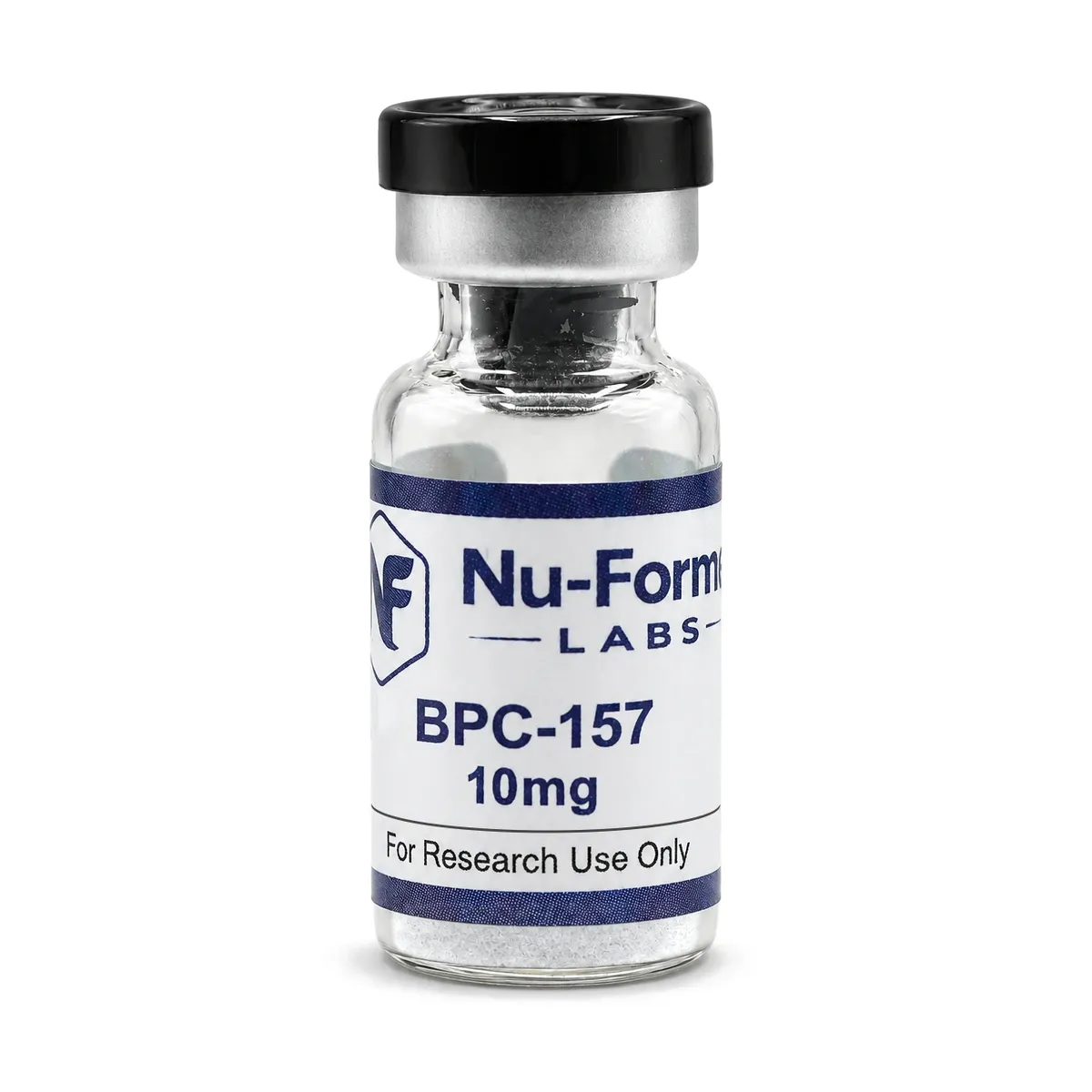
BPC-157 Product Overview
BPC-157 is a synthetic pentadecapeptide composed of 15 amino-acid residues. Its sequence corresponds to a fragment described in the scientific literature in connection with a gastric protein referred to as body protection compound.
Nuforme supplies 10mg of lyophilized BPC-157 in a single vial for controlled laboratory research. The material is intended for researchers investigating peptide behaviour in gastrointestinal, fibroblast, endothelial, connective-tissue and experimental injury models.
The supplied peptide is synthetically manufactured and should not be described as material extracted from human gastric juice or human tissue.
Product Specifications
Product: BPC-157
Expanded name: Body Protection Compound 157
Alternative names: BPC 157, BPC-15, Bepecin, PL 14736
Sequence: Gly-Glu-Pro-Pro-Pro-Gly-Lys-Pro-Ala-Asp-Asp-Ala-Gly-Leu-Val
One-letter sequence: GEPPPGKPADDAGLV
Peptide length: 15 amino-acid residues
Reference molecular formula: C62H98N16O22
Reference molecular weight: 1,419.5 g/mol
Reference CAS number: 137525-51-0
Reference PubChem CID: 9941957
Amount: 10mg
Format: Lyophilized material
Container: Single vial
The reference formula and molecular weight describe the parent free peptide. BPC-157 acetate, BPC-157 trifluoroacetate and other salt forms have different total molecular masses and analytical characteristics.
Researchers should verify the sequence, terminal structure, salt form and peptide content using the product label and batch-specific analytical documentation.
Origin and Nomenclature
BPC-157 is frequently described as a stable gastric pentadecapeptide or as a partial sequence of a larger gastric protein called body protection compound.
These terms describe the historical research context of the sequence. They do not mean that the material in the vial is a naturally occurring human peptide preparation or that it retains the biological function of a complete endogenous protein.
The designation “157” is part of the established compound name and does not indicate that BPC-157 contains 157 amino acids. The defined research peptide contains 15 residues.
Gastrointestinal Research Background
BPC-157 has been investigated extensively in experimental gastrointestinal models, particularly in rodents. Published studies have examined gastric mucosal injury, experimental ulcers, intestinal lesions, fistulas and chemically induced gastrointestinal damage.
Reported endpoints have included lesion size, histological appearance, inflammatory markers, oxidative-stress measures, vascular response and epithelial integrity.
These findings arise primarily from animal and laboratory models. They do not establish that BPC-157 protects the human gastrointestinal tract, treats inflammatory bowel disease, heals ulcers or produces any other therapeutic gastrointestinal effect in humans.
Tendon, Ligament and Muscle Research
Preclinical studies have examined BPC-157 in tendon fibroblast cultures and animal models of tendon, ligament and muscle injury. Experimental endpoints have included fibroblast migration, cellular outgrowth, collagen organization, histological appearance and mechanical characteristics of injured tissue.
Research involving rat tendon fibroblasts has reported changes in cell migration and signalling pathways associated with tissue-remodelling responses. Animal studies have also evaluated tendon-to-bone and muscle-to-tendon healing models.
These observations do not demonstrate accelerated recovery from sports injuries or musculoskeletal damage in humans. Results from surgically created or chemically induced animal injuries cannot be transferred directly to human clinical outcomes.
Endothelial and Angiogenesis Research
BPC-157 has been studied in endothelial-cell and animal models involving angiogenesis, vascular signalling and restoration of blood flow. Reported pathways have included VEGFR2, Akt, endothelial nitric oxide synthase and nitric oxide-associated signalling.
Angiogenesis is a complex and context-dependent process. An increase in endothelial migration, tube formation or vascular markers does not by itself demonstrate complete tissue repair or a beneficial outcome.
Pro-angiogenic findings also require careful safety interpretation. Experimental stimulation of vascular pathways should not be described simply as “improved circulation” or assumed to be beneficial in every biological model.
Nitric Oxide and Vascular Models
Published research has examined interactions between BPC-157 and nitric oxide-related pathways in endothelial cells, isolated vascular tissue and animal models.
Relevant endpoints have included endothelial nitric oxide synthase activity, nitric oxide production, vasomotor responses and endothelial-cell migration.
Results from isolated blood vessels, cultured cells or animal circulation models do not establish a cardiovascular benefit or safety profile in humans.
Potential Research Areas
BPC-157 identity and sequence confirmation
Gastric epithelial and mucosal models
Intestinal barrier and lesion models
Tendon fibroblast migration assays
Connective-tissue and extracellular-matrix research
Collagen organization and matrix remodelling
Endothelial-cell migration and tube-formation assays
VEGFR2 and Akt signalling
Nitric oxide and eNOS-associated pathways
Experimental angiogenesis models
Muscle, tendon and ligament injury models
Formulation compatibility and peptide stability
Peptide degradation and metabolite analysis
Analytical identity, purity and net-content testing
Experimental Design Considerations
Appropriate experimental controls may include untreated samples, vehicle controls, sequence-scrambled peptides and validated positive or negative assay controls.
Researchers should document the species, cell type, tissue source, passage number, injury model, peptide concentration, exposure period and endpoint-measurement method.
Cell migration, angiogenesis, collagen expression and tissue strength are separate experimental outcomes. Improvement in one marker should not be interpreted automatically as complete healing or functional tissue recovery.
Studies of the supplied material should also distinguish BPC-157 from shorter degradation fragments, modified sequences and different salt forms.
Analytical Considerations
Mass spectrometry may be used to confirm the molecular identity of BPC-157 and distinguish the full 15-residue peptide from truncated sequences or degradation products.
HPLC or UPLC can provide information about chromatographic purity. However, an HPLC area percentage does not independently confirm sequence identity, salt form, net peptide content or the total quantity of BPC-157 present in the vial.
Quantitative documentation should distinguish the stated 10mg amount from independently measured net peptide content. Water, residual solvents and counterions may contribute to the total mass of lyophilized material.
Batch documentation should be reviewed for sequence, molecular mass, chromatographic purity, peptide assay, salt form and analytical methods. Sterility, endotoxin level and microbiological quality should not be assumed unless those characteristics have been specifically tested and documented for the individual batch.
Evidence Limitations
Most published BPC-157 research consists of cell-culture and animal studies. Human evidence remains extremely limited and does not establish a validated clinical dosage, long-term safety profile or therapeutic effectiveness.
A small published pilot study included only two adults and was not designed to determine whether BPC-157 treats injuries or other medical conditions. Results from a two-participant safety observation cannot establish general human safety.
Current evidence does not demonstrate that BPC-157 heals human tendons or ligaments, accelerates muscle recovery, repairs joints, treats gastrointestinal disease, regenerates nerves or provides any other medical benefit.
Storage
Store the unopened vial according to the conditions stated on the product label and applicable batch documentation. Keep the material sealed and protected from light, heat and moisture. Laboratory solutions should be handled according to a validated protocol appropriate to the intended analytical method and study design.
For laboratory research only. Not for human consumption or veterinary use. This product is not a drug, medication, supplement or cosmetic and is not intended to diagnose, treat, cure or prevent any disease.