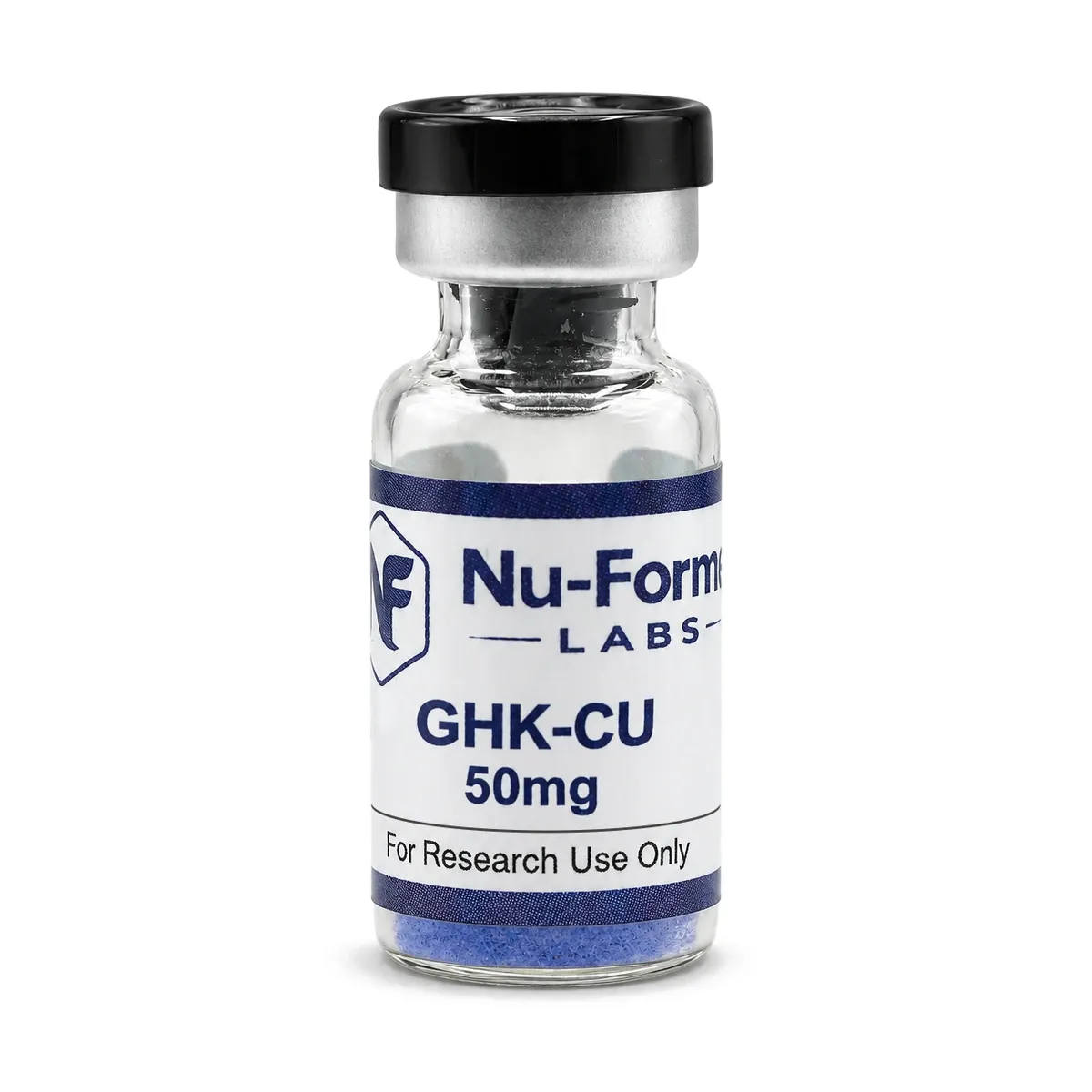
GHK-Cu Product Overview
GHK-Cu is a copper-binding complex formed by the tripeptide glycyl-L-histidyl-L-lysine and copper ions. Nuforme supplies lyophilized GHK-Cu in 50mg and 100mg single-vial formats for controlled laboratory research.
The material is intended for researchers examining peptide–metal coordination, copper-dependent biochemical activity, extracellular-matrix signalling and the behaviour of GHK-Cu in cellular and analytical models.
Product Specifications
Product: GHK-Cu
Expanded name: Glycyl-L-histidyl-L-lysine copper complex
Peptide sequence: Gly-His-Lys
One-letter sequence: GHK
Peptide length: 3 amino-acid residues
Available amounts: 50mg and 100mg
Reference copper stoichiometry: Commonly represented as a 1:1 GHK–Cu complex
Reference CAS number: 89030-95-5
Reference PubChem CID: 71587328
Reference molecular weight: Approximately 402.92 Da for the PubChem reference structure
Format: Lyophilized material
Container: Single vial
Exact molecular formula, charge state, copper stoichiometry, hydration and counterion content may vary between reference conventions and material forms. Researchers should use the product label and batch-specific analytical documentation as the definitive specifications for the supplied material.
GHK and GHK-Cu
GHK is the copper-free tripeptide glycyl-L-histidyl-L-lysine. GHK-Cu is the corresponding copper coordination complex. These materials differ in molecular mass, charge distribution, coordination chemistry and experimental behaviour and should not be treated as interchangeable.
Experimental findings obtained with copper-free GHK do not automatically apply to GHK-Cu. Studies should clearly identify which form was tested and include appropriate peptide-only, copper-only and vehicle controls where relevant.
Copper-Binding Characteristics
The histidine-containing GHK sequence can coordinate copper ions, producing a complex whose behaviour depends on variables such as pH, buffer composition, temperature, competing ligands and the oxidation state of the metal.
Chelating agents, proteins and other copper-binding substances may alter the equilibrium between complexed and unbound species. For this reason, researchers investigating GHK-Cu should document the complete experimental environment rather than treating the nominal vial amount as the only relevant variable.
GHK-Cu Research Background
Published preclinical research has examined GHK-Cu in fibroblast cultures and extracellular-matrix models. Reported research endpoints have included collagen synthesis, glycosaminoglycan production, matrix metalloproteinase expression and other processes associated with cellular and matrix remodelling.
GHK-Cu has also been investigated in animal wound models and in experimental topical formulations. These studies provide research context but do not establish that a lyophilized research material produces therapeutic, cosmetic or regenerative effects in humans.
Results obtained with finished creams, gels, hydrogels, nanoparticles or other delivery systems should not be attributed directly to unformulated GHK-Cu. Vehicle composition, copper availability, exposure conditions and delivery technology may substantially influence experimental outcomes.
Potential Research Areas
Copper-binding and coordination analysis
Comparison of GHK and GHK-Cu
Fibroblast-response models
Collagen and glycosaminoglycan assays
Extracellular-matrix turnover studies
Matrix metalloproteinase expression
Keratinocyte and fibroblast co-culture models
Endothelial and cell-migration studies
Oxidative and redox-response models
Influence of pH, buffers and competing ligands
Formulation compatibility and stability analysis
Identity, purity and copper-content testing
Experimental Controls
Appropriate control groups may include copper-free GHK, a matched copper salt, vehicle controls and untreated samples. When comparing GHK with GHK-Cu, concentrations should be calculated using the molecular mass of the specific material rather than vial mass alone.
Researchers should also account for the possibility of free peptide, unbound copper, counterions and water content when preparing quantitative experiments.
Analytical Considerations
Chromatographic purity alone does not confirm copper content, coordination state or the absence of unbound copper. Depending on the study, useful analytical methods may include HPLC or UPLC for chromatographic purity, mass spectrometry for peptide identity and ICP-MS or elemental analysis for copper quantification.
Batch documentation should be reviewed for the reported identity, assay, purity, copper content and analytical methods. Sterility, endotoxin level, residual solvents and microbiological status should not be assumed unless they are specifically tested and documented for the batch.
The characteristic blue colour commonly associated with copper-peptide complexes may support visual inspection, but colour alone does not confirm identity, purity, concentration or correct copper stoichiometry.
Evidence Limitations
Much of the published GHK-Cu literature consists of laboratory, cell-culture and animal research. Human studies are limited and frequently involve specific topical formulations containing additional ingredients.
Preclinical observations should not be interpreted as evidence that this research material can treat wounds, reverse ageing, stimulate hair growth or provide any other medical or cosmetic benefit in humans.
Storage
Store the unopened vial according to the conditions stated on the product label and applicable batch documentation. Keep the material sealed and protected from light, heat and moisture. Any prepared laboratory solutions should be handled under a validated protocol appropriate to the intended analytical method and study design.
For laboratory research only. Not for human consumption or veterinary use. This product is not a drug, medication, supplement or cosmetic and is not intended to diagnose, treat, cure or prevent any disease.