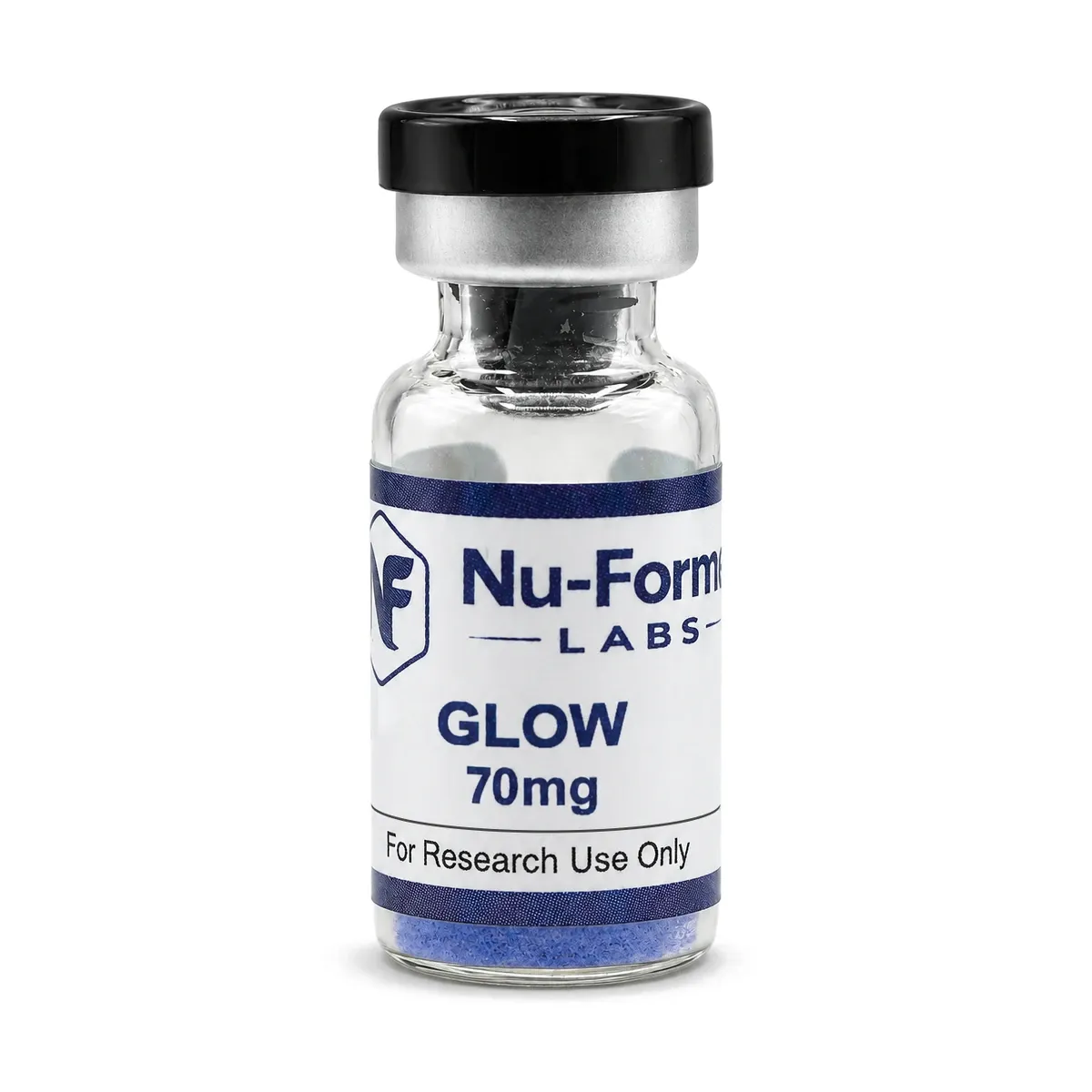
GLOW Product Overview
GLOW combines three research materials in one lyophilized vial: 50mg of GHK-Cu, 10mg of BPC-157 and 10mg of TB-500.
The formulation provides 70mg of total material at a fixed 5:1:1 mass ratio when the components are listed as GHK-Cu, BPC-157 and TB-500.
Supplying the three components together allows the complete formulation to be studied as a single experimental variable. It does not establish that the components produce additive or synergistic effects.
Product Specifications
GHK-Cu: 50mg
BPC-157: 10mg
TB-500: 10mg
Total material: 70mg
Number of components: 3
Component ratio: 5:1:1 by mass
GHK-Cu proportion: Approximately 71.4% by mass
BPC-157 proportion: Approximately 14.3% by mass
TB-500 proportion: Approximately 14.3% by mass
Format: Lyophilized material
Container: Single vial
The stated ratio is a mass ratio, not a molar ratio. Because the three components have different molecular masses, equal milligram quantities do not represent equal numbers of molecules.
GHK-Cu Research Background
GHK-Cu is a coordination complex formed by the tripeptide glycyl-L-histidyl-L-lysine and copper. Experimental research has examined GHK-Cu in relation to fibroblast activity, collagen and glycosaminoglycan accumulation, extracellular-matrix regulation, gene expression and copper-dependent cellular signalling.
The copper complex is chemically different from uncomplexed GHK. Copper content, oxidation state, coordination chemistry and peptide-to-copper ratio are therefore relevant characteristics of the GHK-Cu component.
Findings from cell and animal models should not be interpreted as evidence that GHK-Cu reverses skin aging, improves appearance or repairs human tissue.
BPC-157 Research Background
BPC-157 is a synthetic 15-amino-acid peptide with the sequence GEPPPGKPADDAGLV.
Published research has investigated BPC-157 primarily in cellular and animal models involving fibroblast migration, endothelial response, angiogenesis-associated signalling, nitric-oxide pathways and connective-tissue injury.
The evidence base remains predominantly preclinical. Results from rodent tendon, muscle, gastrointestinal and wound models do not establish corresponding effects in humans.
TB-500 Research Background
TB-500 is a research-market name that is not used consistently across suppliers. Some materials sold as TB-500 correspond to full-length thymosin beta-4, while others are shorter synthetic fragments associated with its actin-binding region.
Research involving thymosin beta-4 has examined actin sequestration, cytoskeletal organization, cell migration, endothelial response and tissue-remodelling models. These findings cannot automatically be attributed to every product labelled TB-500.
The batch documentation should identify the precise TB-500 sequence, sequence length, terminal modifications, molecular formula and expected molecular mass.
Studying the Combined Formulation
GHK-Cu, BPC-157 and TB-500 have separate research histories. Published findings concerning the individual components do not establish the behaviour of the GLOW formulation.
No peer-reviewed study has established the pharmacology, stability, compatibility, safety or effectiveness of the exact 50mg/10mg/10mg combination.
A recent animal study compared BPC-157, TB-500 and their combination in a rat Achilles-tendon model. The combined group did not demonstrate an additional benefit over the individual component groups. That study did not include GHK-Cu and did not evaluate the GLOW formulation.
Synergy must therefore be treated as an experimental hypothesis rather than a product characteristic.
Experimental Design Considerations
A controlled study may compare:
The complete GLOW formulation
GHK-Cu alone
BPC-157 alone
TB-500 alone
Selected two-component combinations
A vehicle or untreated control
Equivalent component concentrations across groups
Because GLOW is supplied at a fixed ratio, the concentration of one component cannot be varied independently of the other two. Separate component materials are required for factorial studies, component-specific controls and independent dose-response experiments.
Potential Research Areas
Blend-versus-component comparisons
Multi-peptide formulation compatibility
Fibroblast migration and proliferation assays
Collagen and extracellular-matrix models
Endothelial and angiogenic-signalling research
Actin and cytoskeletal-response studies
Cell-migration assays
Copper-coordination and redox research
Fixed-ratio concentration-response studies
Peptide–metal interaction analysis
Stability, aggregation and degradation studies
Analytical identity, purity and component-content testing
Formulation Compatibility
Combining a copper complex with two additional peptides introduces chemical and analytical questions that do not arise when the components are studied separately.
GHK-Cu contributes metal-ion coordination chemistry to the formulation. Experimental conditions such as pH, buffer composition, counterions, temperature, light exposure and the presence of other metal-binding molecules may influence copper coordination, solubility and peptide stability.
Compatibility should be measured under the conditions of the intended experiment. Individual component stability does not establish the stability of the co-formulated mixture.
The blue colour commonly associated with GHK-Cu does not confirm the identity, copper ratio, purity or amount of any component in the vial.
Analytical Considerations
GLOW is a mixture and therefore does not have a single molecular formula, molecular weight or CAS number.
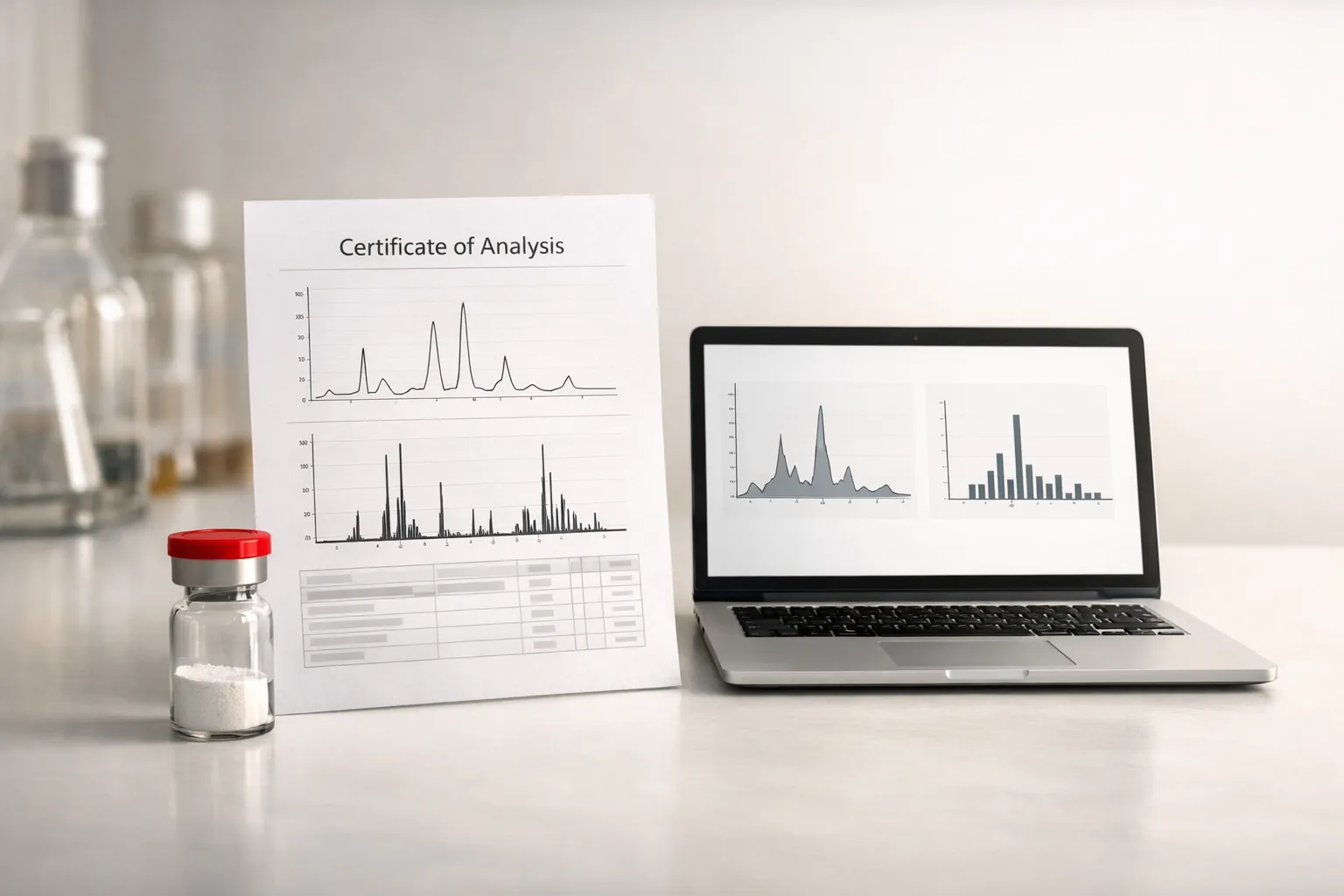
A batch certificate should identify and quantify all three components separately. Reporting only total vial mass or one overall purity percentage does not demonstrate that GHK-Cu, BPC-157 and TB-500 are present at the declared amounts.
Relevant analytical documentation may include:
Identity confirmation for each component
Quantitative content of each component
Exact TB-500 sequence and terminal structure
GHK-to-copper ratio and copper content
Chromatographic separation of component and impurity peaks
Expected and measured molecular masses
Counterion and residual-water measurements
Truncated peptides and deletion sequences
Oxidation, aggregation and formulation-stability data
HPLC or UPLC area percentage is a relative measurement and does not independently confirm milligram content. Multiple components and overlapping peaks can also complicate chromatographic interpretation.
Mass spectrometry and suitable component-specific quantitative methods should be used alongside chromatography where required. Researchers should match the certificate to the lot number printed on the vial.
Evidence Limitations
Evidence concerning an individual component should not be presented as evidence for the complete GLOW formulation.
The blend has not been established to improve skin appearance, increase collagen production, accelerate recovery, repair tendons or ligaments, heal wounds, reverse aging or regenerate human tissue.
The absence of direct interaction studies means that compatibility, antagonism, synergy and the combined biological behaviour of the three components remain unconfirmed.
Storage and Handling
Store the unopened vial according to the conditions stated on the product label and applicable batch documentation. Keep the material sealed and protected from light, heat and moisture.
Multi-component stability should be evaluated under the conditions of the specific experiment. Laboratory preparation, handling and disposal must follow an approved institutional protocol.
For laboratory research only. Not for human consumption or veterinary use. This product is not a drug, medication, supplement or cosmetic and is not intended to diagnose, treat, cure or prevent any disease.