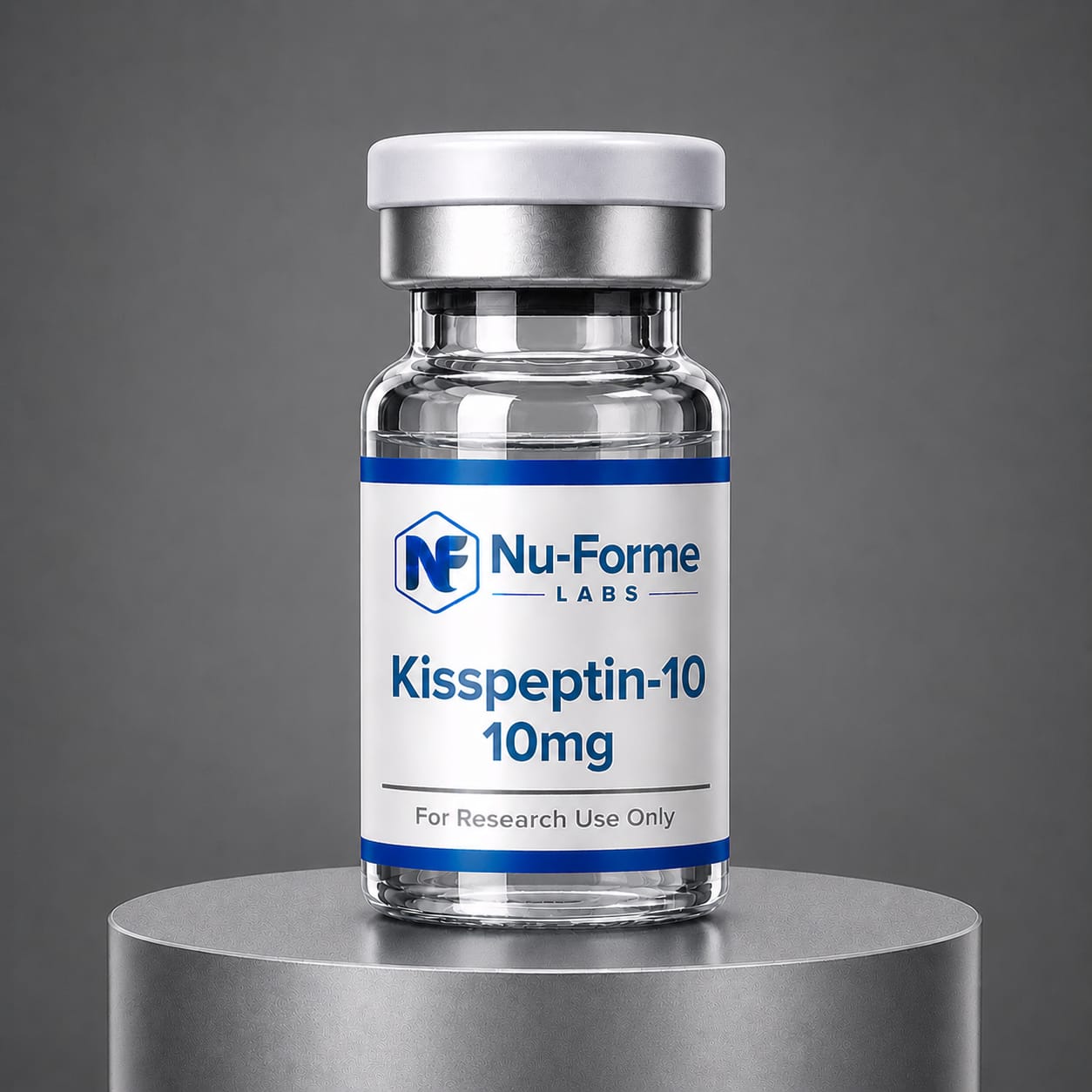
DescriptionWhat Kisspeptin Is
Kisspeptin is a naturally occurring peptide hormone encoded by the KISS1 gene (originally discovered as a metastasis suppressor gene, which is why "kiss" derives from Hershey's Kisses chocolate, made in Hershey, Pennsylvania, where the gene was first identified). It exists in the body in several lengths — kisspeptin-54, kisspeptin-14, kisspeptin-13, and kisspeptin-10 — all of which share the same biologically active C-terminal 10-amino-acid sequence responsible for its effects. It's produced primarily in the hypothalamus, with additional expression in the placenta and other tissues.
Unlike most peptides discussed in this space, kisspeptin isn't a lab-engineered novelty — it's a fundamental, naturally occurring regulator of human reproductive biology that has been extensively studied in academic and clinical endocrinology.
Mechanism of Action
Kisspeptin sits at the top of the hypothalamic-pituitary-gonadal (HPG) axis, functioning as the primary upstream trigger of reproductive hormone signaling:
Kisspeptin neurons in the hypothalamus release kisspeptin
It binds to its receptor, KISS1R (also called GPR54), on GnRH-producing neurons
This stimulates the release of GnRH (gonadotropin-releasing hormone)
GnRH signals the pituitary gland to release LH (luteinizing hormone) and FSH (follicle-stimulating hormone)
LH and FSH then drive the gonads (ovaries/testes) to produce estrogen, progesterone, and testosterone, and regulate ovulation and spermatogenesis
Because of this position at the very top of the reproductive hormone cascade, kisspeptin is considered a "master regulator" of puberty onset, fertility, and reproductive hormone pulsatility.
Areas of Research & Clinical Interest
Area What's Being Studied
IVF / fertility treatment One of the most advanced applications — used as a trigger for egg maturation in IVF cycles, as an alternative to hCG triggers, particularly to reduce risk of ovarian hyperstimulation syndrome (OHSS)
Puberty disorders Studied for diagnosing and treating delayed puberty and precocious (early) puberty, since kisspeptin signaling is central to puberty onset
Hypogonadism Explored as a potential treatment for both male and female hypogonadotropic hypogonadism (low sex hormone levels due to signaling failure)
Diagnostic tool Used in research settings to test HPG axis responsiveness/function
Sexual arousal/behavior Some studies (notably from Imperial College London) have explored kisspeptin's effects on brain regions related to sexual and emotional processing
Menstrual cycle disorders Research interest in conditions involving irregular GnRH/LH pulsatility
Forms Available
Intravenous (IV) infusion — used in most clinical research settings, particularly IVF trigger studies, allowing precise dosing and monitoring
Subcutaneous injection — used in some studies and off-label/research contexts
Not typically available in oral, nasal, or topical form due to its mechanism requiring direct, controlled hormonal signaling
Current Evidence Base
Kisspeptin stands out from most peptides discussed previously because it has a genuinely robust human clinical research base:
Extensive work from Imperial College London (particularly Prof. Waljit Dhillo's team) has run numerous human trials on kisspeptin for IVF triggering, hypogonadism, and reproductive hormone regulation
Multiple peer-reviewed, published clinical trials exist in journals like The Journal of Clinical Endocrinology & Metabolism and Human Reproduction
Used in legitimate hospital-based clinical research protocols, not just animal models or anecdotal biohacking use
Has shown promise specifically in reducing OHSS risk when used as an IVF trigger compared to traditional hCG triggers, while maintaining comparable egg maturation rates in several studies
That said, it is still not an approved standalone pharmaceutical — most use remains within controlled research trials and specialized reproductive endocrinology settings rather than routine clinical practice.