DescriptionKPV Product Overview
KPV is a synthetic tripeptide composed of lysine, proline and valine. Its sequence corresponds to residues 11–13 at the C-terminus of alpha-melanocyte-stimulating hormone, commonly abbreviated α-MSH.
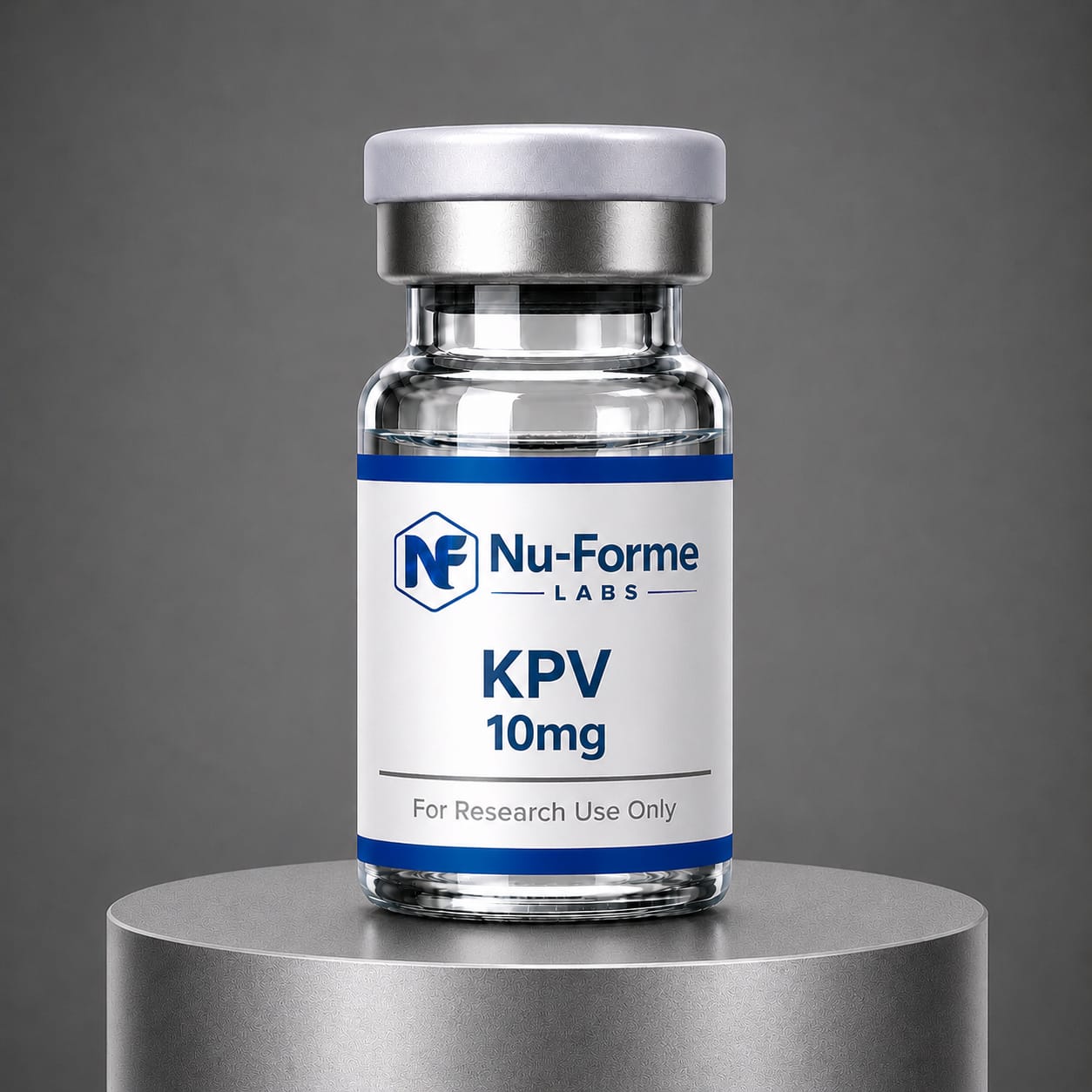
Nuforme supplies 10mg of KPV as lyophilized material in a single vial for controlled laboratory research.
Product Specifications
Product name: KPV
Chemical name: L-lysyl-L-prolyl-L-valine
Sequence: Lys-Pro-Val
One-letter sequence: KPV
Sequence length: 3 amino acids
Reference structure: H-Lys-Pro-Val-OH
α-MSH position: Residues 11–13
CAS number: 67727-97-3
Parent-peptide formula: C16H30N4O4
Parent-peptide molecular weight: 342.43 Da
PubChem CID: 125672
Format: Lyophilized material
Container: Single vial
Relationship to α-MSH
Alpha-melanocyte-stimulating hormone is a 13-amino-acid peptide involved in melanocortin signalling. KPV corresponds to the final three residues of the α-MSH sequence but does not contain the central His-Phe-Arg-Trp melanocortin receptor-binding motif found in the complete hormone.
KPV should therefore be treated as a distinct research material rather than a shortened version expected to reproduce every function of α-MSH. Published studies have examined signalling effects that may occur independently of the classical melanocortin-receptor activity of the complete hormone.
Sequence correspondence also does not establish identical terminal chemistry. The free peptide, acetate salt, amidated derivatives and stereochemical variants must be distinguished analytically.
PepT1 Transport Research
Cellular and animal studies have examined KPV as a substrate for peptide transporter 1, or PepT1. This transporter can carry selected dipeptides and tripeptides across cellular membranes.
In intestinal research models, investigators have studied PepT1-associated uptake of KPV in epithelial cells and macrophages, followed by measurements of NF-κB activity, cytokine expression and tissue-level inflammatory markers.
These findings are specific to the experimental systems and formulations used in the published studies. They do not establish absorption, pharmacokinetics or clinical effects in humans.
NF-κB and Cellular-Signalling Research
NF-κB is a transcriptional signalling system involved in cellular responses to inflammatory stimuli. Laboratory studies involving KPV have measured changes in NF-κB reporter activity, nuclear transport of the p65RelA subunit and expression or secretion of selected signalling molecules.
Research in immortalized human bronchial epithelial cells reported that KPV was associated with reduced p65RelA nuclear import under defined experimental conditions. Other studies have investigated cytokine-related measurements in intestinal epithelial cells, immune-cell models and murine tissues.
These observations describe experimental endpoints and proposed mechanisms. They should not be presented as proof that KPV prevents or treats inflammatory disease.
Epithelial and Barrier-System Research
KPV has been investigated in intestinal epithelial, bronchial epithelial and keratinocyte models. Areas of study include cellular uptake, epithelial stress responses, cytokine-associated signalling and changes in barrier-related experimental measurements.
Mouse colitis studies and engineered delivery-system studies are preclinical models. Results obtained in chemically induced murine models cannot be interpreted as evidence that KPV treats ulcerative colitis, Crohn’s disease or other gastrointestinal conditions in humans.
Potential Research Areas
α-MSH fragment and structure–activity comparisons
PepT1 transport and cellular-uptake assays
NF-κB activation and nuclear-translocation studies
Cytokine-expression measurements
Intestinal epithelial-cell models
Macrophage and immune-cell signalling models
Bronchial epithelial-cell research
Keratinocyte and three-dimensional skin models
Epithelial barrier and tight-junction research
Peptide stability and degradation analysis
Analytical identity, purity and content testing
Evidence Limitations
The KPV evidence base consists primarily of biochemical, cell-culture and animal studies. Published research has not established human pharmacokinetics, clinical effectiveness, appropriate administration, long-term safety or a therapeutic risk–benefit profile.
Laboratory findings do not demonstrate that KPV treats inflammatory bowel disease, ulcerative colitis, Crohn’s disease, psoriasis, eczema, wounds, infections or immune-related conditions.
The absence of reported human adverse events should not be interpreted as evidence of safety when controlled human exposure data are unavailable.
Analytical Considerations
The name KPV is used for multiple chemical forms in the research-material market. Documentation for the individual batch should specify whether the material is the free peptide, an acetate or another salt, or a terminally modified derivative.
The formula C16H30N4O4 and molecular weight of 342.43 Da refer to the unmodified all-L free-acid peptide H-Lys-Pro-Val-OH. Counterions, terminal amidation, hydration and other modifications alter the expected formula and measured mass.
Mass spectrometry can support molecular-identity testing, while HPLC or UPLC can examine chromatographic purity and related impurities. Molecular mass alone cannot confirm amino-acid stereochemistry because L- and D-residue variants can share the same formula and nominal mass.
Quantitative peptide content should be evaluated separately. A high chromatographic purity percentage does not establish that a vial contains the labelled 10mg amount.
Relevant analytical considerations include incomplete coupling, truncated sequences, stereochemical variants, terminal modifications, aggregation, residual solvents, water and counterion content. Researchers should consult the batch-specific certificate of analysis before use.
Storage and Handling
Store the unopened vial according to the conditions stated on the product label and applicable batch documentation. Keep the material sealed and protected from light, heat and moisture. Laboratory preparation, handling and disposal should follow an approved institutional protocol.
For laboratory research only. Not for human consumption or veterinary use. This product is not a drug, medication, supplement or cosmetic and is not intended to diagnose, treat, cure or prevent any disease.