MOTS-c Product Overview
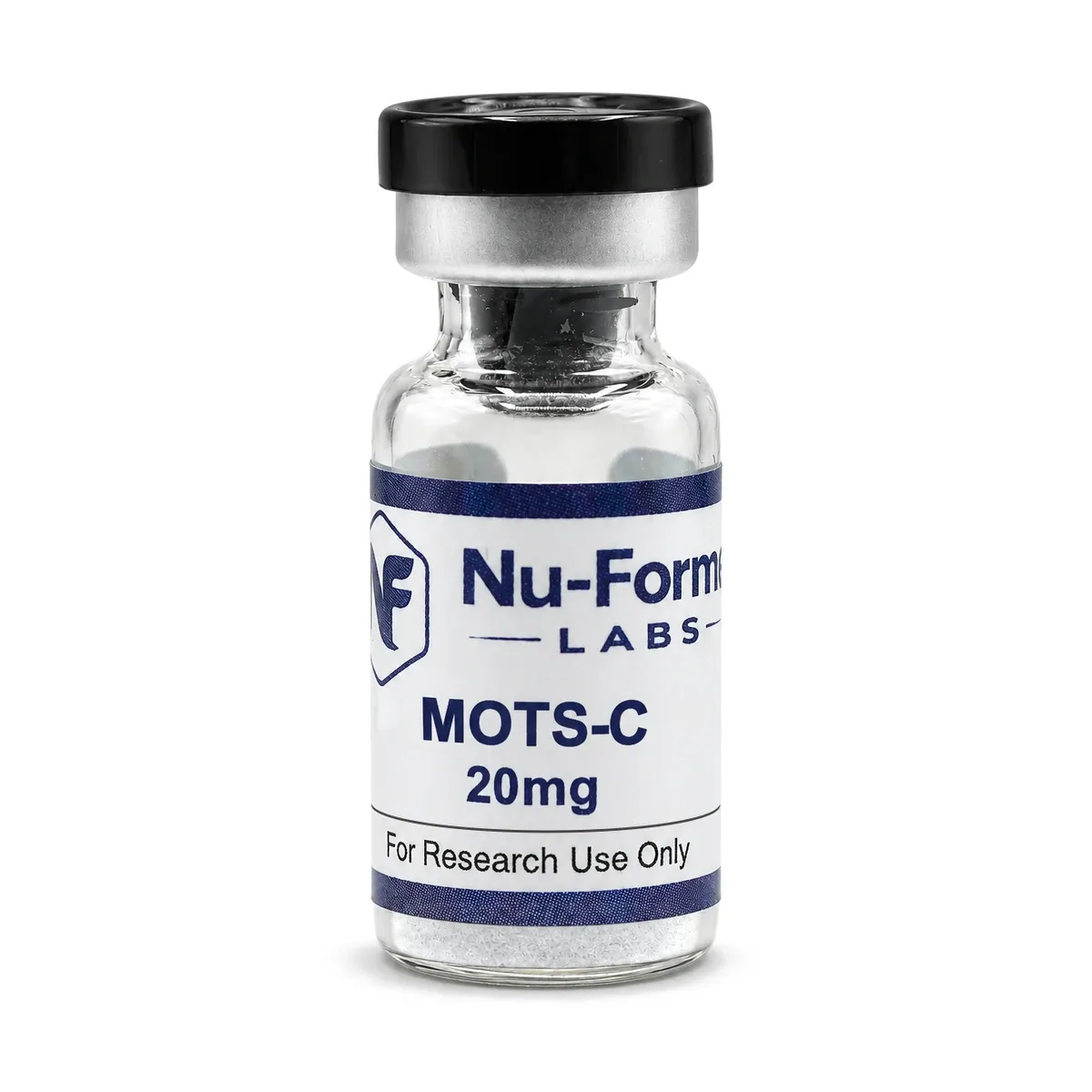
MOTS-c is a 16-amino-acid mitochondrial-derived peptide originally identified from a short open reading frame within the mitochondrial 12S rRNA region. Nuforme supplies 10mg of synthetic MOTS-c as lyophilized material in a single vial.
The supplied research material corresponds to the published human MOTS-c sequence. It is synthetically manufactured and is not extracted directly from mitochondria.
Product Specifications
Product name: MOTS-c
Full name: Mitochondrial Open Reading Frame of the 12S rRNA Type-c
Amount: 10mg
Sequence: MRWQEMGYIFYPRKLR
Sequence length: 16 amino acids
CAS number: 1628958-23-7
Parent-peptide formula: C101H152N28O22S2
Approximate molecular weight: 2174.6 Da
Format: Lyophilized material
Container: Single vial
Mitochondrial-Derived Peptide Research
MOTS-c belongs to a group of short peptides associated with mitochondrial-to-cellular communication. Unlike proteins encoded by nuclear DNA and transported into mitochondria, the endogenous MOTS-c sequence originates from a small open reading frame within mitochondrial DNA.
Research involving MOTS-c has examined how mitochondrial-derived signals may participate in cellular adaptation to changes in nutrient availability, energy demand and metabolic stress.
Metabolic-Signalling Research
Cellular and animal studies have associated MOTS-c exposure with changes in folate and methionine-cycle metabolism, intracellular AICAR accumulation and AMPK signalling.
AMPK is a cellular energy-sensing pathway involved in coordinating metabolic responses when energy availability changes. The relationship between MOTS-c and AMPK is model-dependent and should not be interpreted as a universal property across all tissues, experimental systems or conditions.
Nuclear Translocation and Stress Response
Experimental studies have reported that MOTS-c may translocate to the nucleus under certain forms of metabolic stress. Within these models, nuclear MOTS-c has been investigated in connection with stress-responsive transcription and adaptive gene-expression programs.
The precise molecular targets, transport mechanisms and pathway hierarchy involved in this response remain active areas of investigation.
Potential Research Areas
Folate and methionine-cycle analysis
AICAR and AMPK-signalling studies
Cellular glucose-uptake assays
Metabolic-flux experiments
Mitochondrial-to-nuclear signalling
Nuclear-translocation studies
Cellular responses to oxidative or metabolic stress
Skeletal-muscle cell models
Comparative mitochondrial-derived peptide research
Peptide stability and degradation analysis
Analytical identity, purity and content testing
Evidence Limitations
Published MOTS-c intervention studies consist predominantly of cell-based and animal research. Human studies examining naturally occurring MOTS-c levels, genetic variants or exercise-associated changes do not establish the safety or effectiveness of externally supplied MOTS-c.
Findings concerning metabolism, body composition, exercise performance, age-related processes or cellular stress must not be interpreted as evidence of a therapeutic effect in humans.
Analytical Considerations
Peptide identity may be evaluated using mass spectrometry, while chromatographic methods such as HPLC or UPLC can be used to examine purity and related impurities. Quantitative peptide content should be assessed separately because chromatographic purity does not by itself establish the amount of peptide present in a vial.
Relevant analytical considerations can include methionine oxidation, truncated or deletion sequences, aggregation, residual water and counterion content. The stated molecular formula and molecular weight refer to the parent peptide; measured values may vary depending on salt form, counterions and hydration state.
Researchers should consult the documentation for the individual batch when confirming identity, purity, peptide content and analytical methods.
Storage and Handling
Store the unopened vial according to the conditions stated on the product label and applicable batch documentation. Keep the material sealed and protected from light, heat and moisture. Laboratory handling and disposal should follow an approved institutional protocol.
For laboratory research only. Not for human consumption or veterinary use. This product is not a drug, medication, supplement or cosmetic and is not intended to diagnose, treat, cure or prevent any disease.