DescriptionNA-Selank Product Overview
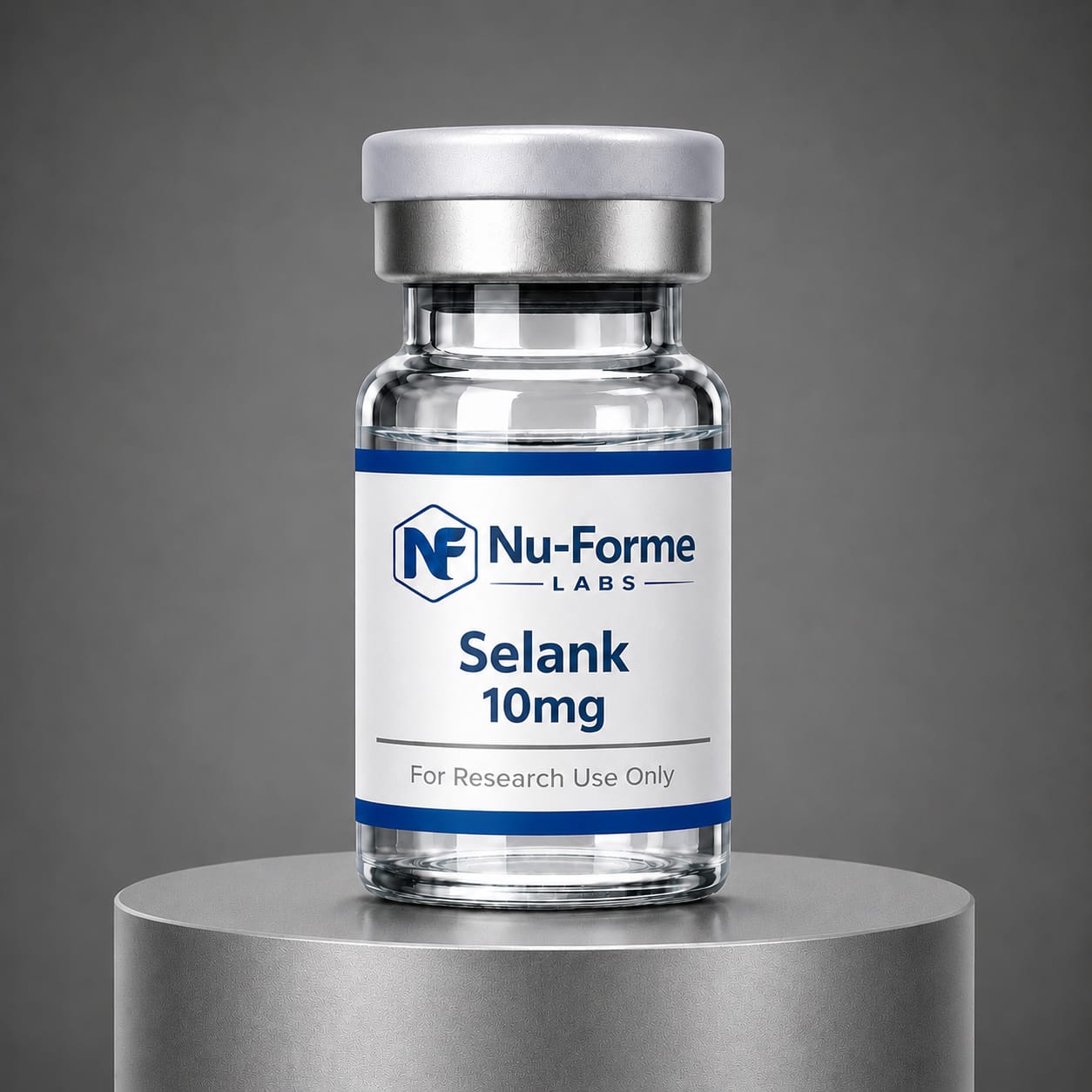
NA-Selank is a synthetic, N-terminally acetylated derivative of Selank supplied as 10mg of lyophilized research material in a single vial.
Selank is a seven-amino-acid peptide derived from the tuftsin sequence Thr-Lys-Pro-Arg, extended at the C-terminus with Pro-Gly-Pro. NA-Selank retains this seven-residue core while incorporating an acetyl group at the N-terminus.
Product Specifications
Product name: NA-Selank
Common expanded name: N-acetyl Selank
Amount: 10mg
Core sequence: Thr-Lys-Pro-Arg-Pro-Gly-Pro
One-letter sequence: TKPRPGP
Sequence length: 7 amino acids
Declared modification: N-terminal acetylation
Format: Lyophilized material
Container: Single vial
Relationship to Tuftsin and Selank
Tuftsin is a naturally occurring tetrapeptide with the sequence Thr-Lys-Pro-Arg. Selank is a synthetic analogue that combines this tuftsin-derived sequence with the tripeptide Pro-Gly-Pro.
NA-Selank is a further modified research analogue in which the free N-terminal amine is acetylated. This structural modification makes NA-Selank chemically distinct from both tuftsin and unmodified Selank.
N-Terminal Acetylation
N-terminal acetylation blocks the free amino group at the beginning of the peptide chain. In peptide chemistry, this modification can affect molecular charge, susceptibility to aminopeptidases and behaviour in biological matrices.
The effect of acetylation must be established under the conditions of the individual experiment. It should not be assumed to provide a specific degree of stability, biological activity or tissue penetration without supporting analytical data.
Selank Research Background
Published research involving the parent peptide Selank has examined GABA-related signalling, neurotransmission-associated gene expression, hippocampal BDNF expression, behavioural models and the expression of genes involved in cytokine and inflammatory pathways.
These findings were produced using particular cellular, animal or experimental systems. Proposed mechanisms remain model-dependent and should not be presented as universal properties of Selank.
Evidence Specific to NA-Selank
Most peer-reviewed Selank literature concerns the unmodified TKPRPGP peptide rather than N-acetyl Selank. Findings obtained with ordinary Selank cannot automatically be attributed to NA-Selank because terminal modification can alter the peptide’s physicochemical and experimental behaviour.
Direct comparison of NA-Selank with unmodified Selank is therefore an important research question rather than an established equivalence.
Potential Research Areas
Comparative analysis of NA-Selank and unmodified Selank
Peptide stability and degradation assays
Aminopeptidase-resistance studies
GABA-related cellular signalling models
Neurotransmission-associated gene-expression research
BDNF-expression models
Tuftsin-derived peptide comparisons
Cytokine and inflammatory gene-expression assays
Cellular stress-response studies
Structure–activity relationship research
Analytical identity, purity and content testing
Important Structural Distinction
The terms “NA-Selank” and “N-acetyl Selank” are not used consistently across the research-material market. Some suppliers use them for N-acetyl Selank with a free C-terminal carboxyl group, while others use them for N-acetyl Selank amidate with a C-terminal amide.
These are different chemical structures:
N-acetyl Selank free acid: Ac-TKPRPGP-OH
N-acetyl Selank amidate: Ac-TKPRPGP-NH2
Because the terminal form affects the molecular formula and calculated molecular mass, researchers should verify the complete sequence, terminal chemistry, salt form and expected mass in the documentation for the individual Nuforme batch. A CAS number should not be assigned unless it corresponds to the exact confirmed structure.
Analytical Considerations
Mass spectrometry can be used to compare the measured molecular mass with the value calculated for the declared terminal structure. HPLC or UPLC can examine chromatographic purity and related impurities, while a separate quantitative method is required to determine the amount of peptide present in the vial.
Chromatographic purity does not establish peptide content. Relevant analytical considerations can include truncated or deletion sequences, incomplete acetylation, terminal-form mismatches, oxidation, deamidation, aggregation, residual water and counterion content.
Researchers should consult the batch-specific certificate of analysis when confirming identity, purity, peptide content and analytical methods.
Evidence Limitations
Research involving Selank and related analogues includes cell-based, animal and limited human studies. Published findings concerning ordinary Selank do not establish that NA-Selank has the same activity, stability, safety profile or experimental effects.
This material should not be described as proven to reduce anxiety, improve mood, enhance memory, increase concentration or treat neurological, psychiatric or immune-related conditions.
Storage and Handling
Store the unopened vial according to the conditions stated on the product label and applicable batch documentation. Keep the material sealed and protected from light, heat and moisture. Laboratory preparation, handling and disposal should follow an approved institutional protocol.
For laboratory research only. Not for human consumption or veterinary use. This product is not a drug, medication, supplement or cosmetic and is not intended to diagnose, treat, cure or prevent any disease.