NAD+ Product Overview
NAD+ is the oxidized form of nicotinamide adenine dinucleotide, a dinucleotide coenzyme present in living cells. It participates in oxidation-reduction reactions and also serves as a consumed substrate for several families of signalling and regulatory enzymes.
NAD+ is not a peptide. It consists of two nucleotides joined through their phosphate groups: one containing nicotinamide and the other containing adenine.
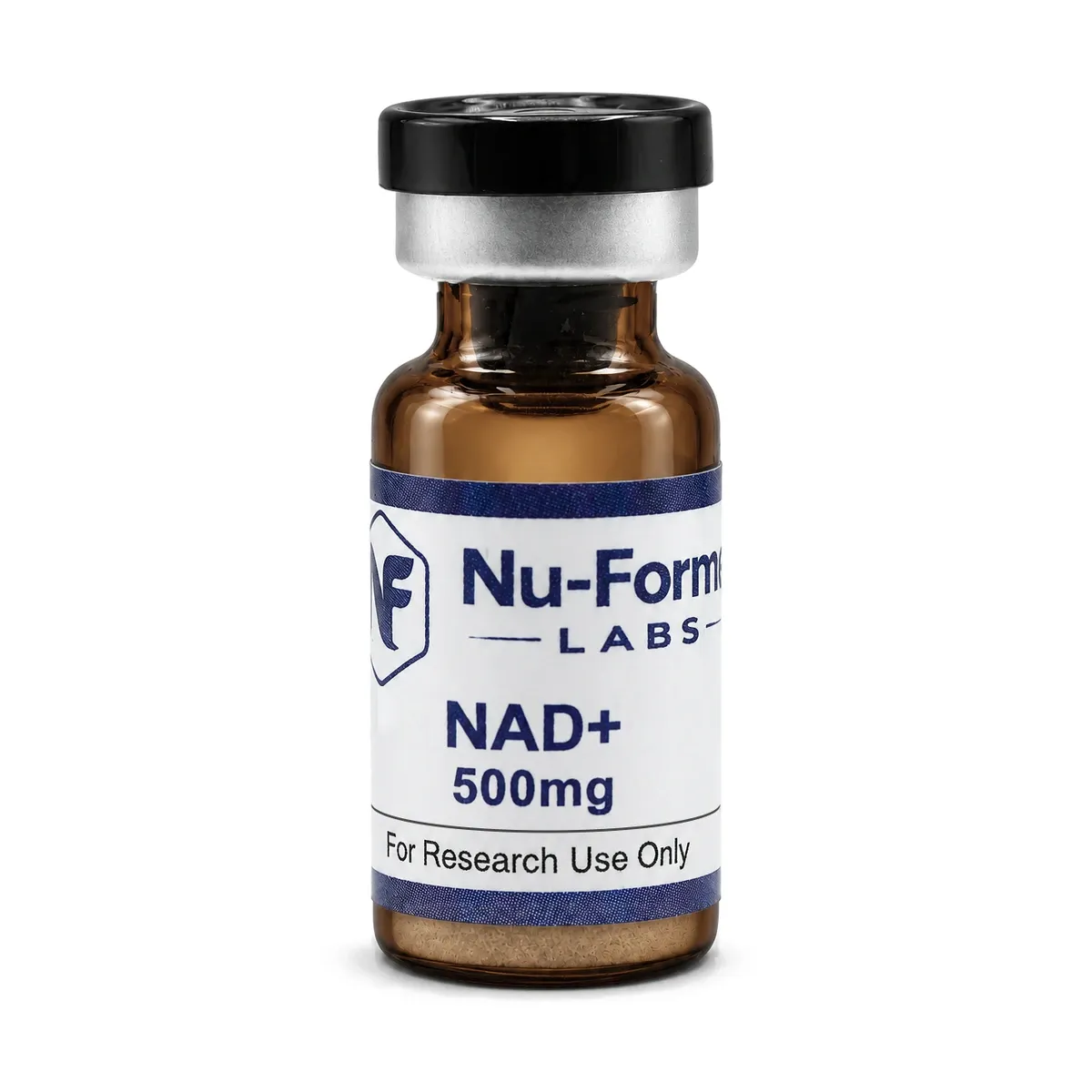
Nuforme supplies NAD+ as lyophilized research material in 500mg and 1000mg vial formats. It is intended for controlled laboratory investigation involving redox chemistry, enzyme activity, metabolic pathways and analytical method development.
Product Specifications
Product name: NAD+
Full name: Nicotinamide adenine dinucleotide
Chemical class: Dinucleotide coenzyme
Redox state: Oxidized
Common parent-compound CAS number: 53-84-9
Parent-compound formula: C21H27N7O14P2
Approximate parent-compound molecular weight: 663.4 g/mol
Available quantities: 500mg or 1000mg per vial
Format: Lyophilized research material
Container: Single vial
NAD+ and NADH Redox Chemistry
NAD+ and NADH form a coupled redox pair. NAD+ accepts a hydride equivalent during enzyme-catalysed oxidation reactions and is converted to NADH. NADH can subsequently transfer reducing equivalents to other biochemical pathways.
This cycling is involved in experimental models of glycolysis, the tricarboxylic acid cycle, fatty-acid oxidation and mitochondrial respiration. NAD+ should not be described simply as producing cellular energy; its function depends on continuous cycling between oxidized and reduced states and on the enzymes present in the selected model.
The NAD+/NADH ratio is often used as an experimental indicator of cellular redox state. Results can differ substantially between the cytosol, mitochondria and nucleus because NAD pools are compartmentalized and regulated independently.
Non-Redox Roles of NAD+
NAD+ also functions as a substrate for enzymes that cleave or transfer portions of the molecule during biochemical reactions.
Sirtuins consume NAD+ during protein deacylation reactions. Poly(ADP-ribose) polymerases use NAD+ in ADP-ribosylation pathways, while enzymes such as CD38 participate in NAD+ degradation and calcium-signalling chemistry.
These reactions connect NAD+ availability with experimental models involving chromatin regulation, DNA-damage responses, protein modification and cellular signalling. However, an association between NAD+ metabolism and these pathways does not establish that externally supplied NAD+ will produce a particular cellular or organism-level outcome.
NAD+ Is Not NADH, NMN or NR
NAD+, NADH, nicotinamide mononucleotide and nicotinamide riboside are chemically distinct research materials.
NADH is the reduced member of the NAD+/NADH redox pair. NMN and NR are biosynthetic precursors that may be converted through specific enzymatic pathways. Findings obtained with one of these compounds should not automatically be attributed to another.
Researchers should confirm the identity, redox state and chemical form of the material before designing comparative experiments.
Potential Research Areas
NAD+-dependent enzyme kinetics
NAD+/NADH redox-ratio studies
Cellular metabolic-flux experiments
Glycolysis and tricarboxylic-acid-cycle research
Mitochondrial respiration models
Sirtuin activity assays
PARP and ADP-ribosylation research
CD38 and NAD+-consumption studies
Cellular compartmentalization of NAD pools
Oxidative-stress and metabolic-stress models
NAD+ stability and degradation analysis
Analytical identity, purity and quantitative-content testing
Considerations for Cellular Research
The addition of NAD+ to an extracellular experimental system does not necessarily produce a corresponding increase in intracellular NAD+.
Membrane permeability, transport mechanisms, extracellular degradation, precursor conversion and intracellular compartmentalization can all influence the measured response. Appropriate controls are required to distinguish direct NAD+-dependent effects from responses involving degradation products or downstream metabolites.
Research concerning age-associated changes in NAD+ metabolism does not demonstrate that this material reverses aging, extends lifespan or improves health. Such outcomes cannot be inferred from biochemical pathway involvement alone.
Chemical Form and Analytical Considerations
Published molecular values commonly refer to the anhydrous parent compound. NAD+ may also be supplied as a salt, hydrate or buffered preparation, which can alter the formula weight and the relationship between total material mass and active NAD+ content.
Researchers should review the documentation associated with the individual batch. Chemical identity, chromatographic purity, redox state and quantitative NAD+ content are separate analytical characteristics.
HPLC or LC-MS methods may be used to distinguish NAD+ from NADH and common degradation products. Quantitative testing should confirm the amount of NAD+ present rather than relying only on chromatographic area purity. Counterions, residual water, buffers and other components should be documented where applicable.
Research Material Boundary
Nuforme NAD+ is supplied as laboratory research material. It should not be represented as a peptide, dietary supplement, injectable preparation, prescription product or pharmaceutical equivalent.
The vial presentation does not by itself establish sterility, clinical potency, safety or suitability for administration. Results from pharmaceutical, nutritional or human studies should not be attributed to this material without appropriate analytical and experimental validation.
Storage and Handling
NAD+ is sensitive to environmental and solution conditions. Store the unopened vial according to the product label and applicable batch documentation. Keep it sealed and protected from inappropriate heat, light and moisture.
Solution preparation, pH, working concentration, storage period and freeze-thaw conditions should be established through validated laboratory procedures appropriate to the intended assay.
For laboratory research only. Not for human consumption, administration or veterinary use. This product is not a drug, medication, supplement or food and is not intended to diagnose, treat, cure or prevent any disease.