DescriptionOxytocin Product Overview
Oxytocin is a naturally occurring cyclic nonapeptide that functions as both a peptide hormone and neuropeptide. Synthetic oxytocin is widely used as a research tool for investigating oxytocin receptor activity, neuroendocrine signalling and the relationship between peptide structure and receptor response.
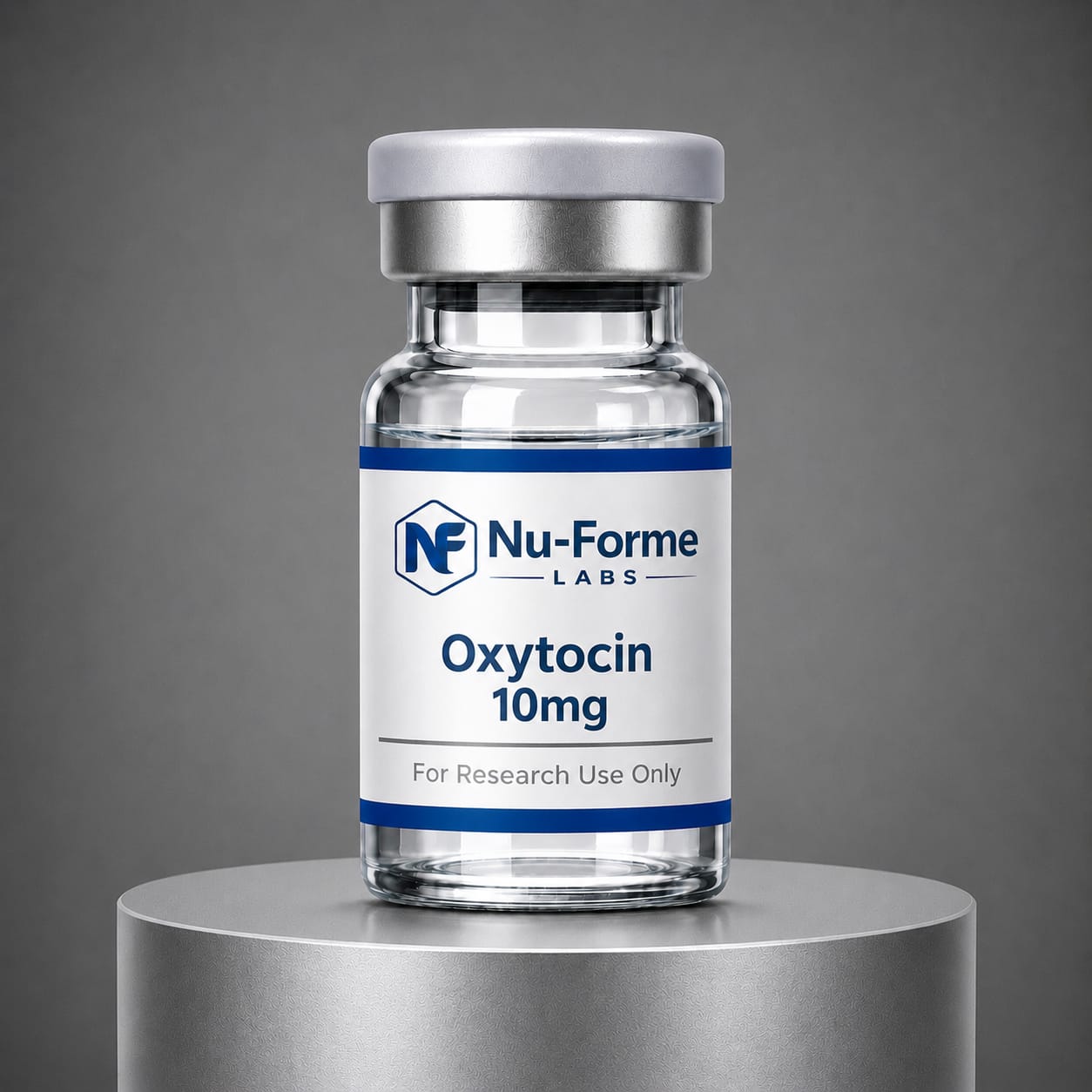
Nuforme supplies 5mg of lyophilized oxytocin research material in a single vial. The product is intended for controlled laboratory studies and analytical investigation.
Product Specifications
Product name: Oxytocin
Peptide class: Cyclic nonapeptide
Canonical sequence: Cys-Tyr-Ile-Gln-Asn-Cys-Pro-Leu-Gly-NH2
Sequence abbreviation: CYIQNCPLG-NH2
Structural feature: Intramolecular Cys1-Cys6 disulfide bond
CAS number: 50-56-6
Parent-peptide formula: C43H66N12O12S2
Approximate parent-peptide molecular weight: 1,007.2 g/mol
Primary research target: Oxytocin receptor (OXTR)
Quantity: 5mg
Format: Lyophilized material
Container: Single vial
Structural Background
Mature oxytocin contains nine amino-acid residues. Six residues form a cyclic region through a disulfide bond between Cys1 and Cys6, while the remaining three residues form a short C-terminal tail ending in an amidated glycine.
The disulfide bond and C-terminal amide are important structural characteristics. Reduced, incorrectly cyclized or non-amidated forms should not be assumed to have the same receptor-binding or signalling properties as correctly folded oxytocin.
Published molecular values usually describe the parent peptide. Research material may be supplied in acetate or another salt form, which can affect the stated formula, measured mass and total material weight. Researchers should verify the exact chemical form using the documentation for the individual batch.
Oxytocin Receptor Signalling
The oxytocin receptor is a class A G-protein-coupled receptor. In many experimental systems, OXTR activation couples predominantly to Gq/11 proteins, stimulating phospholipase C and generating inositol trisphosphate and diacylglycerol. These pathways can produce changes in intracellular calcium concentration and downstream kinase activity.
OXTR coupling is context-dependent. Responses may vary according to cell type, receptor density, membrane environment, ligand concentration and assay duration. Other signalling mechanisms, including alternative G-protein coupling, beta-arrestin recruitment, receptor internalization and desensitization, may also be examined.
Oxytocin has structural similarities to vasopressin-family peptides, and activity at related vasopressin receptors may occur under some experimental conditions. Receptor-selective controls are therefore important when distinguishing OXTR-mediated activity from responses involving AVPR1A, AVPR1B or AVPR2.
Potential Research Areas
Oxytocin receptor binding and activation assays
Gq/11 and phospholipase C signalling studies
Intracellular calcium-mobilization experiments
Concentration-response analysis
Beta-arrestin recruitment and receptor-trafficking assays
OXTR internalization and desensitization studies
Oxytocin and vasopressin receptor selectivity comparisons
Neuroendocrine signalling models
Cellular and preclinical behavioural research
Comparative studies involving oxytocin analogues and antagonists
Peptide stability and degradation analysis
Analytical identity, purity and peptide-content testing
Interpretation of Published Research
Oxytocin has been examined in reproductive, neurological, behavioural and social-signalling research. Findings in these areas are highly dependent on experimental design, species, biological model, route of exposure and the analytical characteristics of the material used.
Results obtained with an approved pharmaceutical formulation, a specific oxytocin analogue or material used in a published study should not automatically be attributed to this research vial. Each batch and experimental system must be evaluated independently.
Research Material and Pharmaceutical Product Distinction
Prescription oxytocin formulations are used in monitored medical environments. These are regulated finished drug products manufactured to defined pharmaceutical specifications.
Nuforme Oxytocin is a separate laboratory research material. It should not be represented as a prescription product, pharmaceutical equivalent or medication. A lyophilized research vial does not by itself establish pharmaceutical sterility, clinical potency, safety or suitability for administration.
Analytical Considerations
Researchers should review the documentation associated with the individual batch before beginning an experiment. Identity, chromatographic purity and peptide content are separate analytical characteristics and should not be treated as interchangeable.
Mass spectrometry may be used to evaluate molecular identity, while HPLC or UPLC can assess chromatographic purity. Appropriate analytical methods should also consider disulfide-bond formation, C-terminal amidation, oxidation, reduction, aggregation and degradation products.
Quantitative peptide-content testing is required to confirm the amount of peptide present. Counterions, residual water and other batch-specific characteristics may affect the total vial mass and should be documented where relevant.
Storage and Handling
Store the unopened vial according to the product label and applicable batch documentation. Protect the material from inappropriate heat, light and moisture. Preparation, solution stability and experimental storage conditions should be established through validated laboratory procedures.
For laboratory research only. Not for human consumption, administration or veterinary use. This product is not a drug, medication, supplement or cosmetic and is not intended to diagnose, treat, cure or prevent any disease.